Math is part of everyday life, even before children learn to recognize numbers or solve equations. From counting toys to comparing the sizes of objects, young children encounter mathematical ideas throughout their daily routines. One of the simplest ways parents can support this development is by talking about math during ordinary activities.
These conversations, often called math talk, help children understand numbers, shapes, patterns, measurements, and relationships through familiar experiences. Rather than introducing complicated lessons, parents can encourage curiosity by asking questions, describing quantities, and exploring mathematical ideas together.
Developing Early Math Skills is an important part of preparing children for future learning. At Montessori Reggio Academy, hands-on educational experiences encourage children to discover mathematical concepts through exploration, problem-solving, and meaningful interactions.
Understanding how everyday conversations support mathematical thinking can help families create valuable learning opportunities at home.
Why Talking About Math Matters in Early Childhood
Children begin developing mathematical understanding long before entering kindergarten.
They notice differences in size, recognize patterns, compare quantities, and explore how objects fit together. These early discoveries provide a foundation for more advanced mathematical concepts.
When parents use mathematical language during everyday activities, children begin connecting words with experiences.
For example, saying, “You have three blocks, and I have two,” introduces counting and comparison naturally.
Similarly, asking, “Which container holds more water?” encourages children to think about quantity and measurement.
These interactions help children understand that mathematics is useful beyond the classroom.
1. Build Number Recognition Through Everyday Conversations
Recognizing numbers is one of the first steps toward developing mathematical understanding.
Parents can introduce numbers during familiar routines without requiring worksheets or memorization exercises.
Count stairs while walking, identify numbers on calendars, or discuss how many toys are in a basket.
For younger children, begin with small quantities and gradually introduce larger numbers.
Activity idea: During snack time, place three crackers on a plate and count them together.
Ask your child to point to each cracker as you say the numbers.
This helps connect spoken number words with actual quantities.
As children become more comfortable, encourage them to count independently.
2. Encourage Mathematical Thinking Through Questions
Asking thoughtful questions helps children move beyond memorizing numbers.
Open-ended questions encourage observation, reasoning, and problem-solving.
Instead of immediately explaining an answer, invite your child to think about different possibilities.
For example, ask:
- “How many blocks do we need to finish the tower?”
- “Which toy is longer?”
- “What happens if we add another cup?”
- “How can we divide these equally?”
- “Which shape would fit in this space?”
These conversations encourage children to explain their thinking.
Even when their answers are incorrect, discussing their reasoning provides valuable learning opportunities.
3. Introduce Shapes During Daily Activities
Shapes are everywhere in a child’s environment.
Doors, windows, plates, books, and building blocks provide opportunities to recognize geometric forms.
Parents can point out circles, squares, rectangles, and triangles during ordinary activities.
For example, while preparing breakfast, discuss the shape of a plate or the rectangular shape of a cereal box.
Activity idea: Organize a shape hunt around the house.
Ask your child to find objects that resemble circles, squares, and triangles.
Older children can compare shapes and discuss their characteristics.
These experiences strengthen visual recognition and spatial awareness.
4. Use Cooking to Explore Measurement
Cooking provides an engaging introduction to mathematical concepts.
Children can explore quantities, measurements, sequencing, and comparisons while helping prepare simple meals.
Parents might ask children to count ingredients, compare measuring cups, or observe how containers hold different amounts.
For example, discuss the difference between a full cup and a half-full cup.
Activity idea: Invite your child to help measure ingredients for a simple recipe using age-appropriate tools.
Ask questions such as, “Do we need more or less?” or “Which measuring cup is bigger?”
These activities connect mathematical language with practical experiences.
5. Teach Patterns Through Play
Recognizing patterns is an important part of early mathematical development.
Patterns help children notice relationships and predict what comes next.
Parents can introduce simple patterns using colors, shapes, sounds, and movements.
For example, arrange blocks in a red-blue-red-blue sequence.
Ask your child which color should come next.
Activity idea: Create a movement pattern by clapping twice and tapping once.
Repeat the sequence and invite your child to continue.
These playful experiences encourage memory, observation, and logical thinking.
6. Practice Comparing Sizes and Quantities
Understanding differences between objects helps children develop mathematical reasoning.
Words such as bigger, smaller, taller, shorter, heavier, lighter, more, and fewer introduce important concepts.
Parents can incorporate comparisons into everyday conversations.
For example, while organizing toys, ask which stuffed animal is larger.
During outdoor play, compare the heights of two plants.
Activity idea: Gather several safe household objects and arrange them from shortest to tallest.
Encourage your child to explain their choices.
These activities develop observation, classification, and measurement awareness.
7. Encourage Counting During Outdoor Exploration
Outdoor activities provide natural opportunities for mathematical discovery.
Children can count flowers, compare leaves, identify shapes, or observe patterns in nature.
A walk through the neighborhood can become an engaging learning experience.
For example, ask your child to count trees along a path or identify how many birds are sitting nearby.
Activity idea: Collect a few large, safe natural objects and sort them by size or color.
Discuss how many objects belong in each group.
Outdoor math conversations encourage curiosity while helping children connect mathematical concepts with their surroundings.
8. Introduce Simple Addition and Subtraction Naturally
Children can begin understanding addition and subtraction through everyday situations before learning written equations.
Parents can demonstrate how quantities change when objects are added or removed.
For example, place two toy cars on a table and add another.
Ask, “We had two cars, and now we have one more. How many do we have?”
Similarly, remove one object and discuss how many remain.
Using familiar materials makes mathematical relationships easier to understand.
The goal is to build understanding rather than pressure children to memorize answers.
9. Make Math Conversations Positive and Encouraging
Children develop confidence when learning experiences feel enjoyable and supportive.
Avoid creating pressure around correct answers.
Instead, recognize effort, curiosity, and problem-solving.
If your child makes a mistake while counting, encourage them to try again.
You might say, “Let’s count together and see what we discover.”
Positive interactions help children understand that mathematics involves exploration and practice.
Parents should also avoid expressing negative beliefs about their own mathematical abilities.
Demonstrating curiosity and enthusiasm can help children approach math with greater confidence.
How Montessori Education Supports Early Math Skills
Montessori education emphasizes learning through concrete materials and hands-on experiences.
Instead of introducing abstract mathematical concepts immediately, children explore quantities, shapes, patterns, and relationships using physical objects.
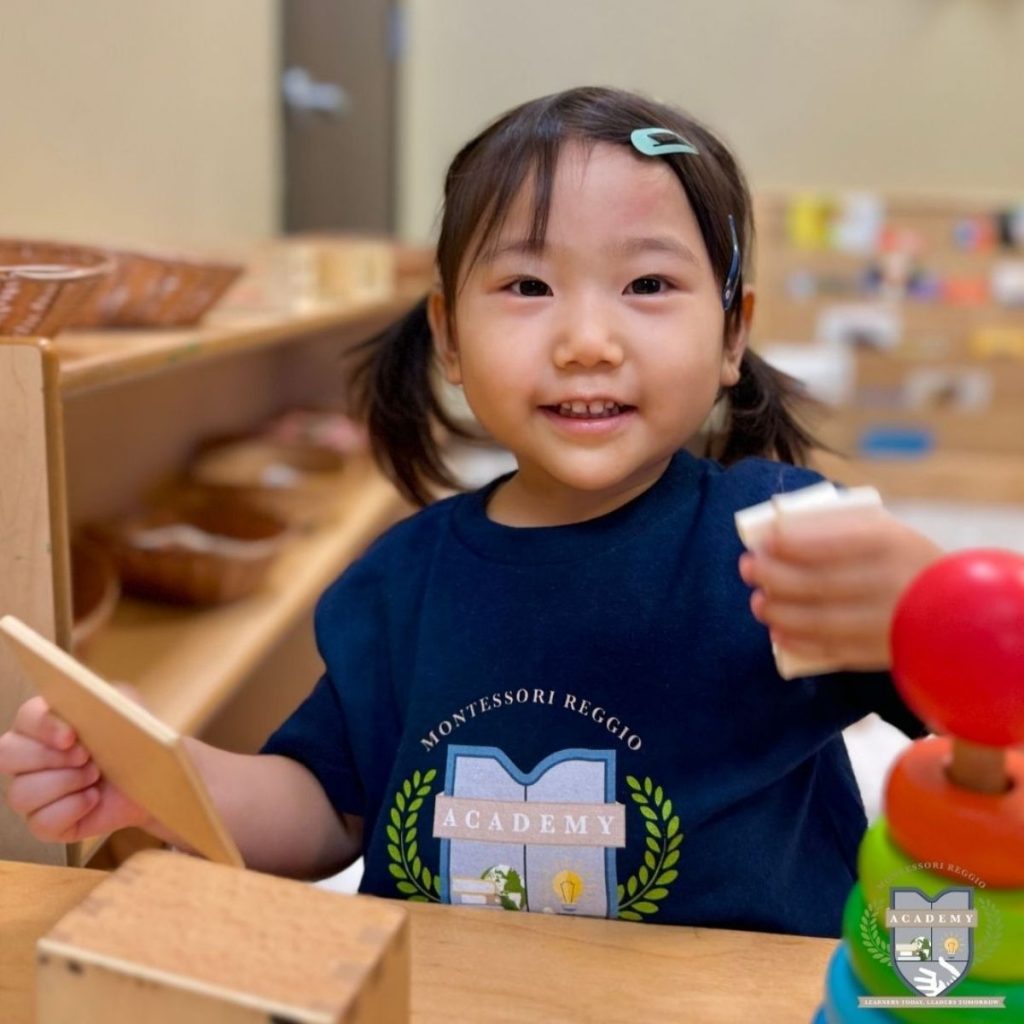
For example, Montessori mathematical materials may include number rods, counting beads, numeral cards, and geometric shapes.
These materials help children connect numbers with visible quantities.
At Montessori Reggio Academy, mathematical learning is integrated into its Montessori and Reggio Emilia-inspired educational approach.
Children have opportunities to explore number recognition, counting, mathematical reasoning, geometry, and problem-solving through developmentally appropriate activities.
The academy’s educational philosophy also encourages independence and self-directed discovery, allowing children to develop understanding through meaningful experiences.
Supporting Mathematical Learning at Montessori Reggio Academy
Montessori Reggio Academy serves families in Sugar Land and Katy, Texas, providing educational programs that support academic, social, emotional, and practical development.
Its curriculum incorporates Montessori materials, Reggio Emilia-inspired projects, and STEAM learning opportunities.
Children are encouraged to investigate mathematical ideas through hands-on activities that promote curiosity and critical thinking.
Rather than focusing exclusively on memorization, the academy emphasizes understanding concepts and applying knowledge.
Teachers provide guidance while respecting individual learning styles and developmental readiness.
For families interested in strengthening Early Math Skills, this educational approach provides opportunities to connect mathematical learning with practical experiences.
Simple Ways Parents Can Continue Math Learning at Home
Parents can reinforce classroom learning through small daily interactions.
Counting groceries, discussing shapes, comparing objects, and identifying patterns are all valuable opportunities.
Try incorporating mathematical conversations during mealtimes, playtime, shopping trips, and family activities.
Allow children time to respond to questions and explain their ideas.
Most importantly, keep activities enjoyable.
Children benefit from discovering that math is not limited to books or classrooms. It is something they can explore throughout everyday life.
Final Thoughts
Talking about math with young children is a simple yet meaningful way to support early mathematical development.
Everyday conversations about numbers, shapes, measurements, patterns, and quantities help children connect abstract concepts with familiar experiences.
Through playful questions, hands-on activities, and positive encouragement, parents can help children develop confidence and curiosity about mathematics.
At Montessori Reggio Academy, mathematical learning is supported through Montessori materials, collaborative exploration, and developmentally appropriate educational experiences.
By combining supportive classroom instruction with meaningful math conversations at home, families can help children build a strong foundation for future academic success.