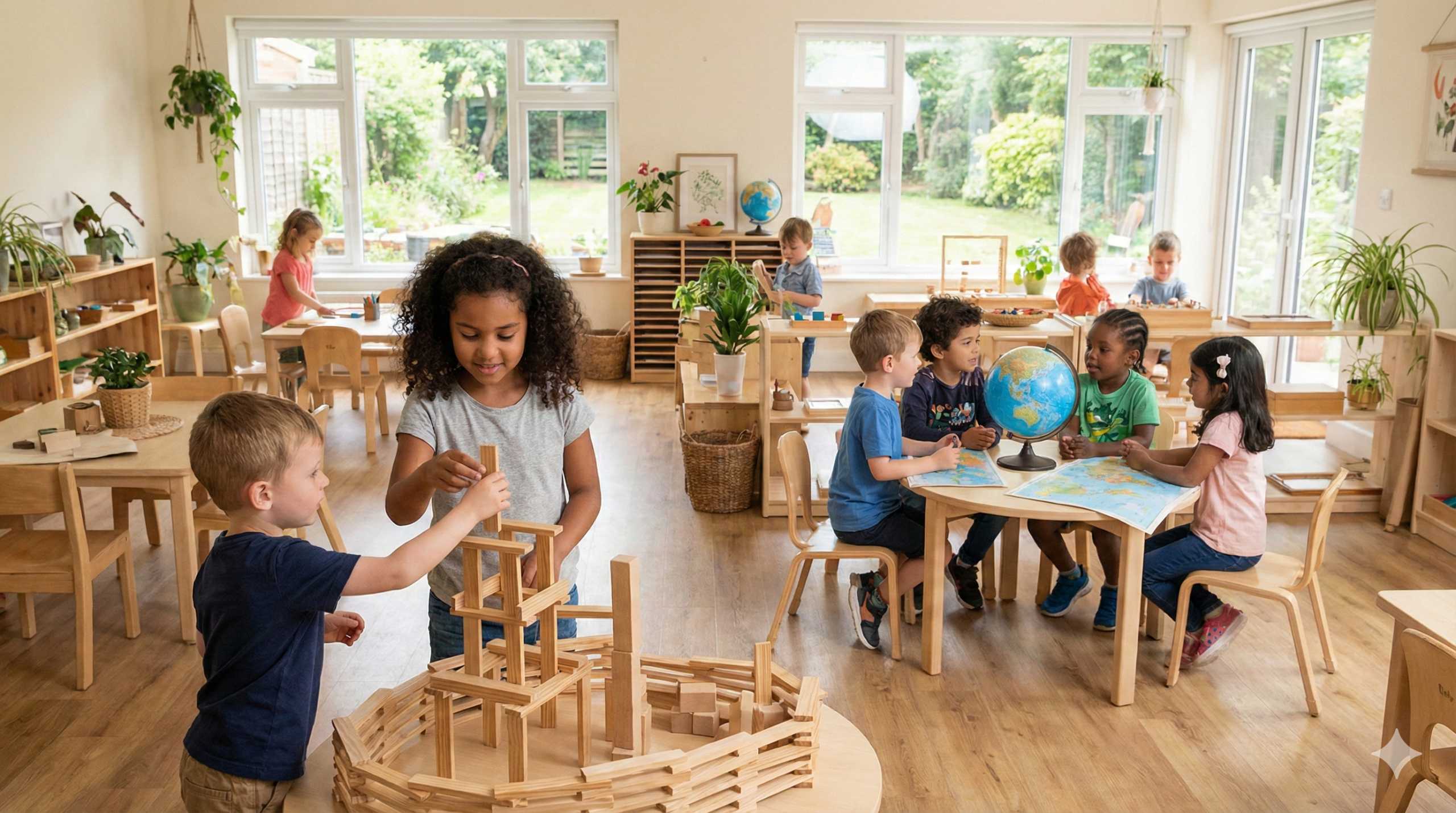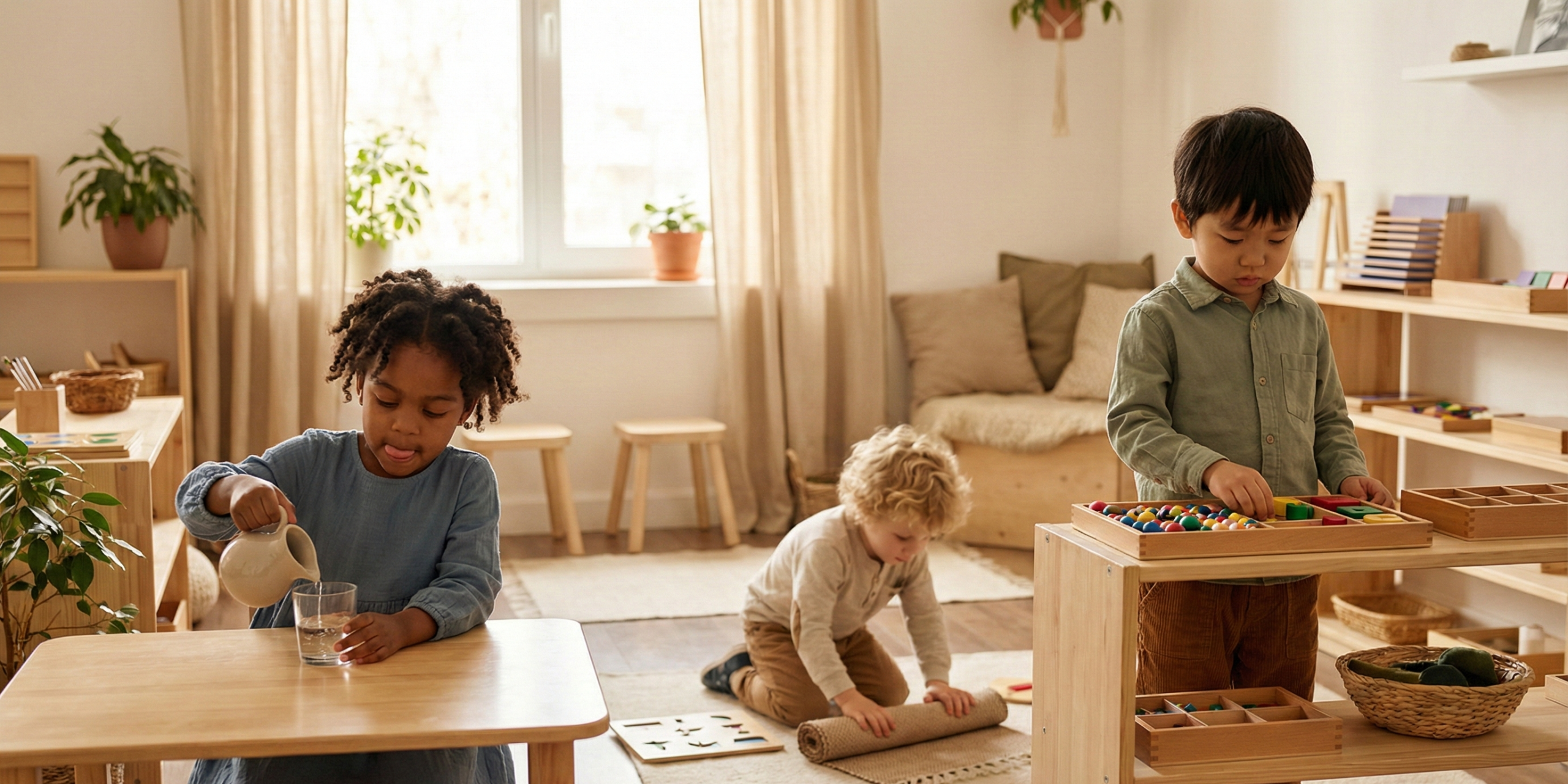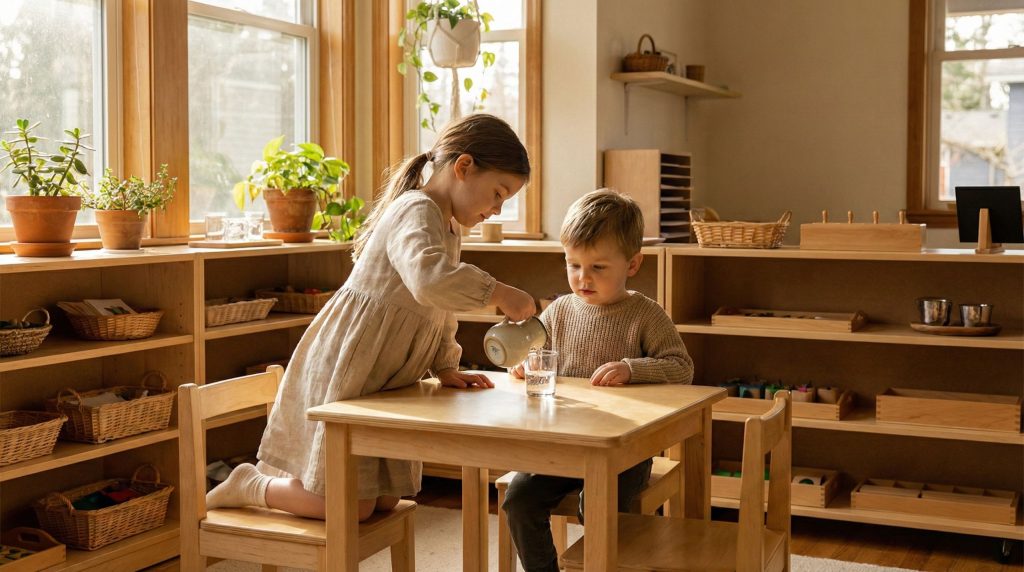
When parents walk into our classrooms for the first time, many are surprised by what they see. There are no rows of desks facing a teacher at the front. No worksheets handed out in unison. Instead, three-year-olds work alongside five-year-olds, choosing their own activities from beautifully arranged shelves. An older child kneels beside a younger one, demonstrating how to pour water from pitcher to cup without spilling a drop. Across the room, another student works intently with colorful sensorial materials, completely absorbed in the task.
This is what sets our approach apart—and it is deeply rooted in how Montessori, Reggio Emilia, and Cambridge create a cohesive education at our academy. We believe children thrive when they can learn at their own pace in a collaborative, family-like community. Our mixed-age classrooms build remarkable confidence and independence as older students mentor younger peers, reinforcing their own learning in the process.
Why We Choose Mixed-Age Classrooms
The decision to group children ages three to six together is not arbitrary. It reflects decades of educational research and our direct experience observing how children naturally learn from one another. In traditional same-age classrooms, children are often compared against rigid developmental benchmarks, creating unnecessary pressure and anxiety. Our mixed-age structure eliminates this artificial constraint.
Research consistently demonstrates that children in mixed-age environments develop stronger social-emotional skills, enhanced language abilities, and greater cognitive flexibility. When we remove the expectation that all children must learn the same material at the same pace, something remarkable happens: each child’s unique developmental trajectory becomes visible and celebrated.
The Family-Like Community
Our classrooms mirror the natural social structures children experience in families and communities. Rarely do children interact exclusively with peers of exactly the same age outside of school, so why would we create this unnatural environment in their learning space? In our mixed-age rooms, children develop long-term relationships that span multiple years. A three-year-old entering our program will spend up to three years with the same guide and many of the same peers, creating deep bonds and a profound sense of belonging.
Dr. Maria Montessori observed that these multi-year relationships transform classrooms into communities “cemented by affection,” where children come to know each other’s characters and develop reciprocal feelings for one another’s worth. We witness this daily: older children naturally protect and care for younger ones, while younger children look to their older peers with admiration and trust.
A Morning in Our Prepared Environment
Let us walk you through what a typical morning looks like, so you can understand how self-directed learning unfolds in practice.
Arrival and the Work Period Begins (8:00-8:30 AM)
Children arrive at their own pace during our arrival window. There is no mandatory morning meeting that interrupts the flow. Instead, each child has developed their own morning ritual. Some immediately choose a work from the shelf—perhaps the pink tower or the sandpaper letters. Others might greet a friend and share a story from the weekend. A few will head to the practical life area, drawn to the activity of preparing a snack for themselves and their classmates.
Our guides observe carefully during this time. They note which children gravitate toward which materials, who is ready for a new lesson, and which peer interactions are forming. This is not idle observation—it is the foundation of individualized instruction.
The Three-Hour Uninterrupted Work Period
This extended work period is fundamental to the Montessori approach. Without these long, uninterrupted stretches, the method simply does not work. During this time, children move freely throughout the prepared environment, selecting activities that match their current interests and developmental needs.
Practical Life Station: Here you might see a four-year-old teaching a three-year-old how to polish a mirror using a small cloth and natural polish. The older child demonstrates slowly and deliberately, breaking down each movement. The younger child watches intently, then tries independently. If she struggles, the older child does not take over—instead, she offers gentle encouragement and models the movement again.
This interaction benefits both children profoundly. The younger child gains not just the skill itself, but the confidence that comes from learning in a supportive, non-judgmental environment. The older child reinforces her own mastery by teaching, developing patience, empathy, and leadership skills that will serve her throughout life.
Sensorial Area: Across the room, a five-year-old works independently with the color tablets, arranging shades from lightest to darkest. A three-year-old observes from a respectful distance, fascinated. The older child notices and invites her younger peer to sit beside her. “You can help me find the lightest pink,” she offers. This simple moment of inclusion teaches cooperation, generosity, and the joy of shared discovery.
Language and Mathematics: Meanwhile, our guide sits with a small group, presenting a new phonetic sound to two four-year-olds who are ready for this lesson. The children are not grouped by age but by readiness—a core principle that allows each child to progress at their optimal pace without the pressure of keeping up with or being held back by the whole group.
Grace and Courtesy in Action
Throughout the morning, we see grace and courtesy lessons naturally integrated into the rhythm of the day. A child who needs to pass behind another working on the floor says softly, “Excuse me, please.” A student who accidentally knocks over another’s work immediately stops to apologize and help rebuild it. These are not behaviors enforced through external rewards or punishments—they arise from genuine respect and community feeling that develops in our mixed-age environment.
When conflicts do arise, older children often step in to help mediate. We have witnessed five-year-olds calmly helping younger peers articulate their feelings: “Use your words. Tell him you didn’t like that.” This peer-to-peer conflict resolution builds emotional intelligence and problem-solving capacity in ways that adult intervention alone cannot achieve.
The Science Behind Self-Directed Learning
Parents frequently ask us: “How do you know my child is learning if they are just choosing what they want to do?” This question reflects a fundamental misunderstanding of how young children learn best.
Self-directed learning is not a free-for-all. It is carefully structured freedom within a thoughtfully prepared environment. Every material on our shelves has been selected for its educational purpose. Every activity builds specific skills—fine motor coordination, concentration, order, independence, and academic concepts.
Intrinsic Motivation: The Key to Lifelong Learning
When children have the freedom to choose their activities, they develop intrinsic motivation—the internal desire to learn because it feels meaningful and enjoyable, not because they expect a prize. Research shows that intrinsically motivated children engage more deeply, develop better problem-solving skills, and demonstrate stronger emotional regulation than children who learn primarily through external rewards.
We see this principle in action daily. A child who chooses to work with the binomial cube does not need stickers or praise to stay engaged for twenty minutes. The work itself is the reward—the satisfaction of mastering a challenge, the joy of discovery, the pride of accomplishment. These are the feelings that sustain learning throughout life.
Contrast this with traditional approaches that rely heavily on external motivators. Studies demonstrate that when children are frequently rewarded for behaviors they already enjoy, their natural interest actually fades. They become dependent on incentives and less likely to act positively unless something is offered in return. Our approach cultivates the opposite: children who love learning for its own sake.
Building Executive Function and Independence
The self-directed work period builds crucial executive function skills. Children learn to plan their day, manage their time, make decisions, and follow through on commitments. A four-year-old might think through her morning: “First I will work with the pink tower, then I will prepare a snack, then I will practice my letter sounds.”
These planning and decision-making skills transfer directly to academic success and life skills. Children who direct their own learning develop a growth mindset—they understand that mistakes are learning opportunities rather than failures. They build cognitive resilience, the ability to persevere when facing challenges.
The Role of Older Children as Mentors
One of the most powerful dynamics in our mixed-age classrooms is the natural mentorship that emerges between older and younger children. This is not forced or contrived—it arises organically from the structure of the environment.
Teaching Deepens Learning
When a five-year-old teaches a three-year-old how to use the practical life pouring activity, something profound happens. The older child must organize her thoughts, recall the proper sequence of steps, and communicate clearly. This process of teaching solidifies and deepens her own understanding.
Educators have long recognized that we learn material most thoroughly when we teach it to others. In our classrooms, older children have daily opportunities to be teachers, stretching their communication skills and reinforcing their knowledge. Research confirms that this peer teaching benefits the older child as much as the younger one, building self-confidence, patience, and a sense of responsibility.
Leadership Without Authority
Our mixed-age structure gives older children authentic opportunities to practice leadership. Unlike adult authority figures, an older child leading a younger peer operates from a place of empathy and recent experience. The five-year-old remembers what it was like to struggle with that same task just a year or two ago.
This creates a particular kind of mentorship characterized by patience and understanding. We often observe older children allowing younger ones to struggle productively, offering hints rather than taking over, waiting patiently for the younger child to work through the challenge independently. These are sophisticated teaching skills that many adults struggle to master.
Addressing Common Parent Concerns
We understand that mixed-age classrooms can feel unfamiliar and raise questions. Let us address the most common concerns we hear from prospective parents.
“Will my advanced child be held back by younger students?”
This is perhaps the most frequent worry we hear from parents of older or advanced children. The concern is understandable but misplaced. In our classrooms, being grouped with younger children does not mean easier lessons.
Our curriculum provides enormous breadth and depth. A five-year-old who has mastered foundational skills can work with advanced mathematics materials, complex language work, or intricate cultural studies. The presence of younger children does not limit her—in fact, it offers her valuable opportunities to practice leadership and deepen her learning by teaching.
Research shows no evidence that mixed-age classrooms negatively impact academic achievement. In fact, studies demonstrate that older children in mixed-age settings often outperform peers in same-age classrooms on measures of executive function, reading, vocabulary, and social problem-solving.
“Will my younger child be overwhelmed or intimidated?”
Parents of younger children sometimes worry their three-year-old will be intimidated by the presence of five-year-olds. Again, we understand this concern, but our daily experience tells a different story.
Younger children are not intimidated—they are inspired. They watch older peers with admiration and naturally aspire to master the same skills. This observation and modeling accelerates their development in remarkable ways. A three-year-old who sees a four-year-old successfully working with the moveable alphabet is motivated to learn her letter sounds. She has a clear, relatable model of where she is heading developmentally.
Furthermore, the presence of older, more capable peers provides emotional support and social learning that same-age peers cannot offer. Younger children gain confidence from the protective, nurturing relationships that develop with their older classmates.
“How do you ensure each child gets individual attention?”
Our mixed-age structure actually enhances individualization rather than diminishing it. Because children are at different developmental stages, we never attempt to teach the entire class the same material at the same time. Every lesson is individualized or delivered to small groups based on readiness, not age.
The extended three-year cycle means our guides develop deep knowledge of each child’s strengths, challenges, learning style, and interests. This continuity of relationship allows for truly personalized instruction. A guide who has worked with a child for two or three years knows exactly which materials will hook that particular child onto a new concept, what kind of environment helps her concentrate best, and when she needs a gentle push versus patient waiting.
Why This Approach Prepares Children for Life
The skills children develop in our mixed-age classrooms extend far beyond academic content. They learn to collaborate with people of different ages and abilities—a reality they will face in every job, every community, every family situation throughout their lives.
They develop emotional intelligence, learning to read social cues, regulate their own emotions, show empathy, and resolve conflicts peacefully. They build genuine self-confidence that comes not from adult praise but from real mastery and meaningful contribution to their community.
Perhaps most importantly, they develop a love of learning itself. Not learning to please adults or earn rewards, but learning because discovery brings joy, because mastery brings satisfaction, because growth brings meaning.
This is the foundation we build during these critical early years. When children leave our program to enter primary school or beyond, they carry with them the confidence to work independently, the curiosity to ask questions, the resilience to persist through challenges, and the kindness to support others. These are the qualities that lead to success in school and in life.
Why Parents Trust Montessori Reggio Academy
Our commitment to mixed-age classrooms reflects our deeper philosophy: that children are individuals who develop along their own unique timelines, within the context of a supportive community. This approach requires tremendous expertise, careful observation, and a genuinely prepared environment—hallmarks of our program.
As Texas’ first Cambridge Early Years Center, we combine the time-tested wisdom of Montessori and Reggio Emilia approaches with the globally recognized Cambridge framework. This unique blend gives your child access to world-class educational methodologies while maintaining the warm, family-like atmosphere of our mixed-age classrooms.
Our Cognia accreditation and eight consecutive years as “Best of Sugar Land” reflect our commitment to educational excellence. But what matters most is what you will see when you visit: children working with deep concentration, older students patiently guiding younger ones, and an atmosphere of joyful purpose that can only emerge when we honor how children naturally learn.
People Also Ask
Q: What age range works best in a mixed-age Montessori classroom?
Montessori classrooms typically group children in three-year age spans: 3-6 years for primary programs, allowing older children to serve as mentors while younger ones benefit from observation and peer learning. These specific age groupings align with distinct developmental planes identified through decades of educational research.
Q: Will my child be bored if they already know the material?
Children in mixed-age classrooms are never held to a single curriculum level—they work at their individual pace regardless of age, accessing advanced materials when ready and gaining leadership skills by helping younger peers. Teaching others actually deepens the older child’s understanding while building confidence and communication skills.
Q: How does self-directed learning prepare children for traditional schools?
Self-directed learning builds executive function, time management, decision-making, and intrinsic motivation—skills that transfer directly to academic success in any setting. Research shows Montessori students demonstrate superior executive function, social problem-solving, and reading skills compared to traditionally educated peers.
Q: Do younger children really learn from watching older children?
Younger children naturally absorb advanced vocabulary, complex problem-solving approaches, and sophisticated social skills by observing older peers, accelerating their language development and cognitive growth. This peer-to-peer learning is often more effective than adult instruction because children relate to and aspire to emulate their slightly older classmates.
Ready to see our mixed-age classrooms in action? Visit our Katy campus and witness how self-directed learning and peer mentorship create confident, curious learners. Schedule a tour to experience the difference a mixed-age community makes.