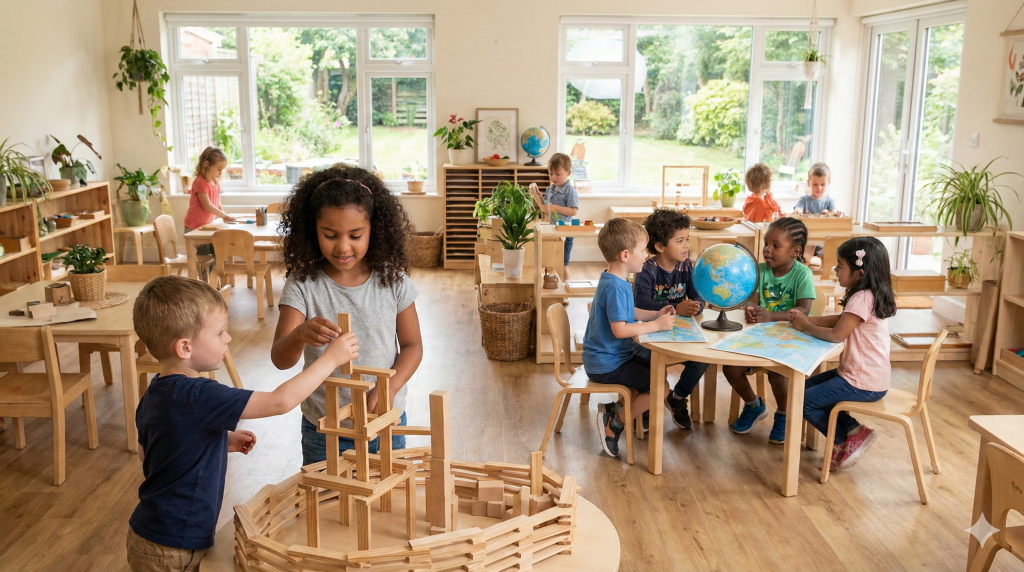
When parents envision their child’s future, the conversation rarely stops at test scores or reading levels. The real question—the one that keeps thoughtful parents awake at night—is whether their child will have the confidence to navigate an uncertain world, the compassion to lead with integrity, and the perspective to thrive in an increasingly interconnected society.
We believe true leadership begins with curiosity, compassion, and a respect for others. By immersing children in a diverse community representing over 30 countries and a globally-focused curriculum, we prepare them to become principled and confident future leaders.
This commitment isn’t aspirational marketing. It reflects our daily classroom practice, where the educational philosophies we’ve carefully integrated create an environment uniquely designed to cultivate the traits that distinguish tomorrow’s leaders.
What Leadership Actually Means in Early Childhood Education
The concept of leadership in early education has little to do with titles, authority, or outward charisma. Effective leadership begins with self-knowledge, develops through respect for others, and manifests in the ability to solve problems collaboratively while maintaining one’s principles.
Research from early childhood leadership development programs consistently demonstrates that children who develop autonomy, self-regulation, and collaborative skills in their earliest years carry these capacities throughout their educational trajectory. The Montessori method, which forms one pillar of our educational approach, has produced notable leaders including Google founders Larry Page and Sergey Brin and Amazon founder Jeff Bezos—not because it teaches business strategy to preschoolers, but because it builds the foundational qualities that enable leadership: independence, resilience, and respect for others.
Our definition of leadership rests on two core values articulated in our brand framework: Leadership and Diversity. These values are inseparable. A child cannot develop genuine leadership capacity in a homogeneous bubble. True leadership emerges when a child learns to navigate difference with curiosity rather than fear, to listen before speaking, and to recognize that multiple valid perspectives can coexist.
The Path from Self-Direction to Confidence
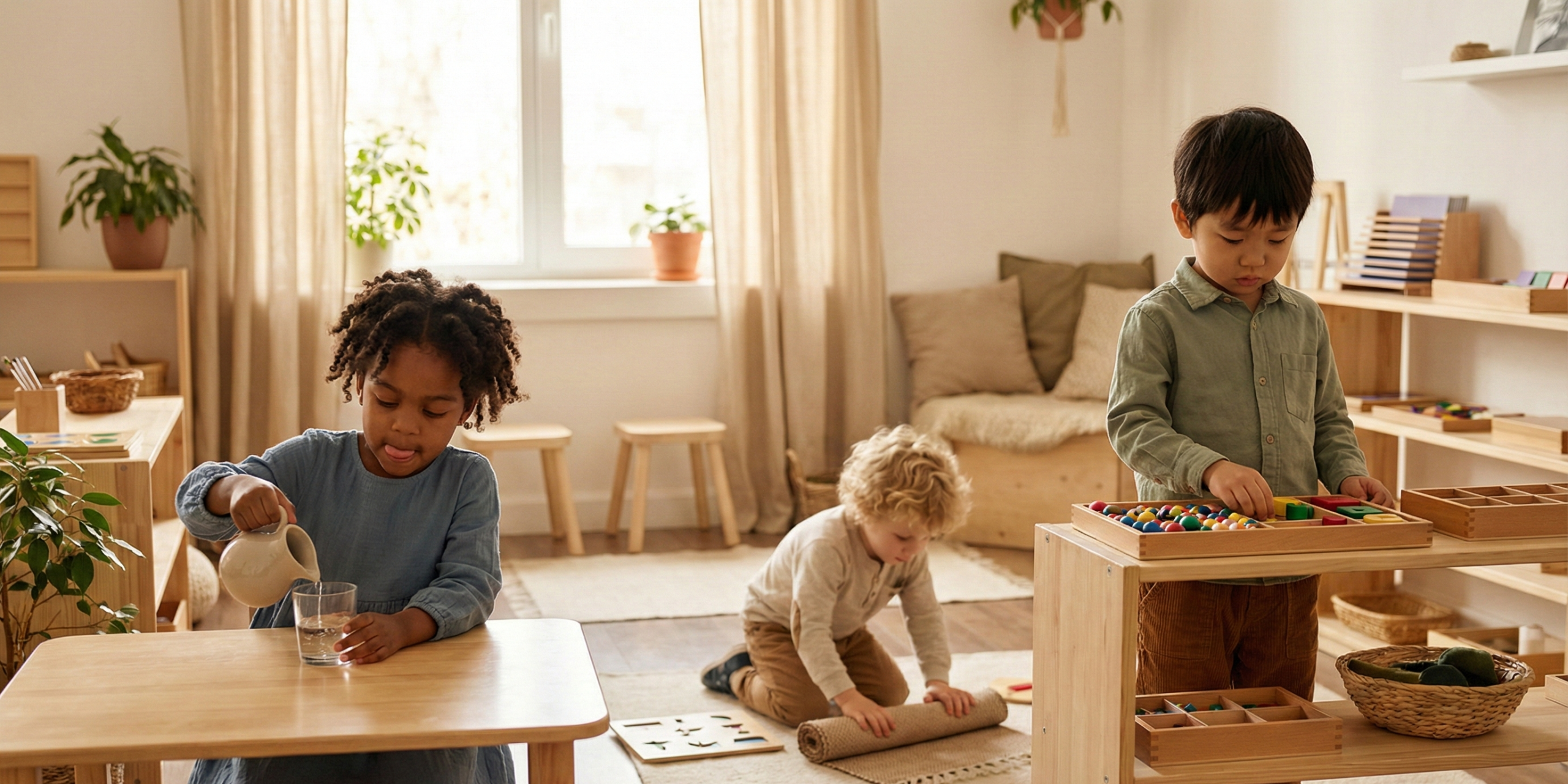
Every morning in our classrooms, a four-year-old makes a choice that appears simple but carries profound developmental significance: which work to pursue, for how long, and with whom. This freedom—bounded by respect for others and the structured environment we’ve prepared—initiates a developmental cascade that builds confident, self-directed learners.
Self-directed learning, a cornerstone of Montessori education, allows children to take initiative in their learning journey. When children choose their work, they’re not simply picking an activity. They’re practicing executive function, managing their time, and learning to trust their own judgment. These are the precise skills that distinguish adults who pursue their goals with determination from those who wait for external direction.
The research evidence supports what we observe daily: in well-designed self-directed learning environments, students’ motivation increases alongside their feelings of control, confidence, and self-belief. A child who successfully completes a challenging task they’ve chosen develops a fundamentally different relationship with difficulty than a child who completes the same task because a teacher assigned it. The first child learns, “I can tackle hard things.” The second learns, “I can do what I’m told.”
This internal locus of control—the belief that one’s actions shape outcomes—is perhaps the single most important predictor of leadership capacity. Our mixed-age classrooms amplify this effect. When a five-year-old observes a six-year-old working through a complex math material and then successfully attempts it themselves weeks later, they’re not just learning mathematics. They’re learning that growth happens through sustained effort, that challenges are temporary, and that they possess the capacity to master what initially seems impossible.
How Mixed-Age Classrooms Build Leadership Through Mentorship
Our mixed-age classroom structure, spanning three-year age ranges, might initially seem like an administrative convenience. In reality, it’s one of our most powerful tools for developing leadership capacity and social-emotional intelligence.
Consider what happens when a three-year-old enters a Primary classroom already populated by four-, five-, and six-year-olds. The youngest children observe how the classroom functions, absorbing social norms and academic expectations from slightly older peers who remember what it felt like to be new. This modeling is extraordinarily effective—research demonstrates that young children often learn more readily from near-age peers than from adults, because the developmental distance is small enough to seem achievable.
More significant is what happens to the oldest children in the classroom. By their third year, these children have transitioned from observers to mentors. When a six-year-old shows a three-year-old how to carry a tray of water without spilling, they’re simultaneously reinforcing their own understanding (the “protégé effect”), practicing patience, and experiencing the satisfaction of service to others. This is leadership in its purest form: using one’s knowledge to elevate another person.
Studies of mixed-age classroom environments consistently document enhanced social skills, reduced bullying, increased feelings of security and confidence, and stronger empathy development. The structure naturally reduces competition—it’s difficult to feel threatened by a three-year-old’s accomplishments when you’re five, and it’s equally difficult to feel discouraged when children at every skill level surround you. Each child can locate themselves on a visible developmental continuum, understanding that growth is inevitable with time and effort.
The Global Perspective: Diversity as Educational Infrastructure
Our community represents over 30 countries. This is not a statistic we mention to signal cosmopolitan sophistication. It’s the foundational infrastructure that makes our approach to leadership development possible.
When children spend their formative years in genuinely diverse environments, they develop what researchers call “cultural competence”—the ability to navigate across differences in language, custom, and perspective without anxiety or prejudice. This competence doesn’t emerge from celebrating International Day once per year or reading multicultural books (though we do both). It develops through daily interaction with peers whose home languages, family structures, and cultural practices differ from one’s own.
A child in our classroom might hear Spanish spoken during arrival, observe a classmate’s grandmother in traditional Indian dress during pickup, and work alongside a peer whose family recently relocated from Nigeria. These experiences don’t feel like “diversity education” to the child—they simply represent normal life. And that normalization is precisely the point. Research demonstrates that early exposure to diversity leads to stronger critical thinking skills, greater social awareness, and increased cognitive flexibility.
The contrast with more locally-focused programs is significant. While competitors like The Honor Roll School provide quality education within their model, their community orientation tends toward families from similar geographic and cultural backgrounds. There’s nothing inherently problematic about this, but it does limit the global perspective children naturally develop. Our families choose us specifically because they value raising children who will navigate an interconnected world with confidence and cultural fluency—children who view difference as interesting rather than threatening.
The Cambridge Early Years framework we’ve implemented reinforces this global orientation. As Texas’ first Cambridge Early Years Center, we provide a globally recognized curriculum that connects our students’ development with the broader world. The framework’s holistic approach—spanning Communication, Language and Literacy; Creative Expression; Mathematics; Personal, Social and Emotional Development; Physical Development; and Understanding the World—ensures children develop knowledge and skills recognized internationally while remaining deeply rooted in play-based, child-centered learning.
Problem-Solving: The Daily Practice of Leadership
Leadership and problem-solving are functionally synonymous. A leader is someone who can identify a problem, generate possible solutions, select and implement a course of action, and adjust based on results. These are precisely the skills our students practice dozens of times daily.
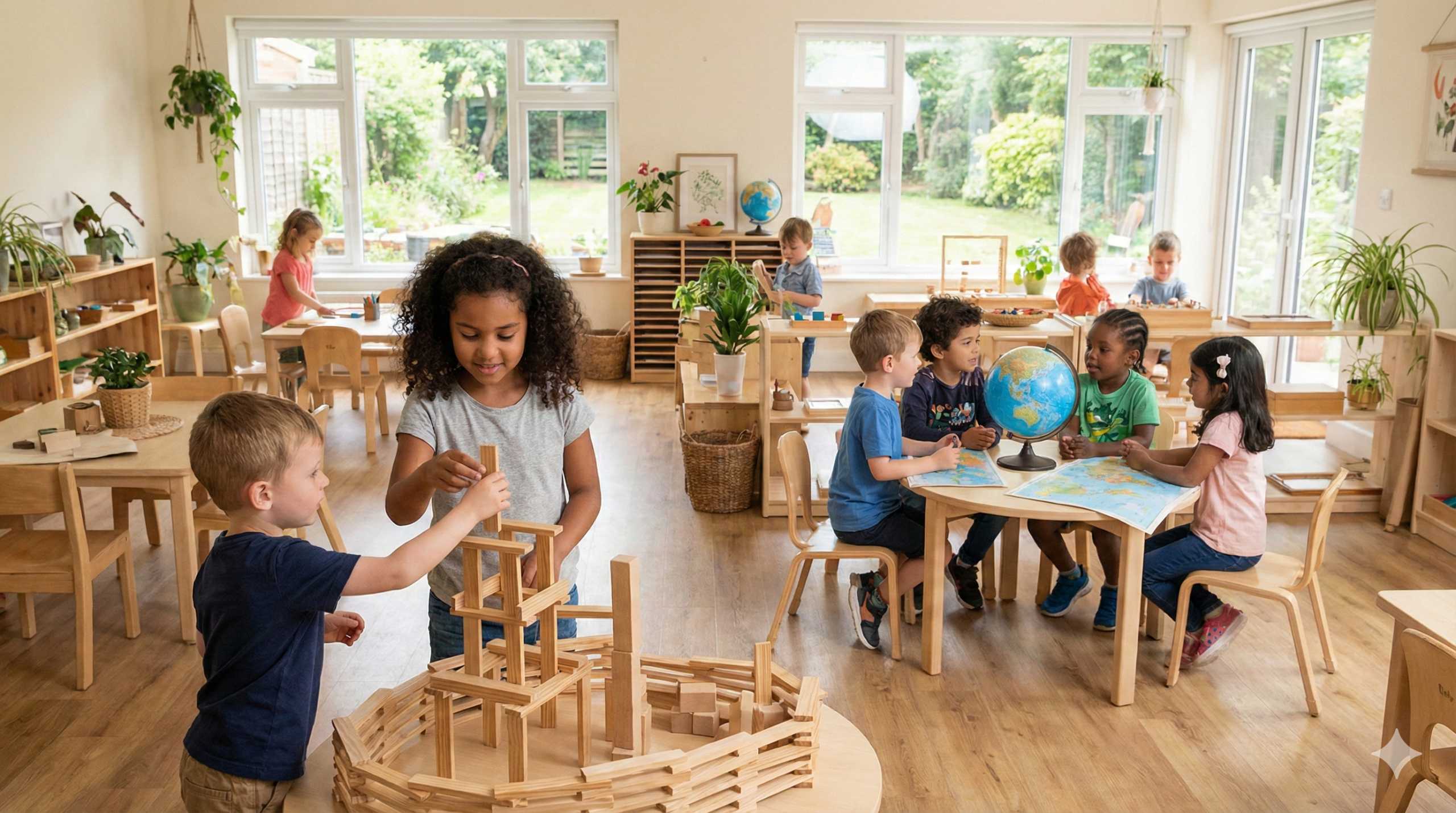
In a Reggio Emilia-inspired environment, which forms another pillar of our educational approach, children are viewed as capable researchers constructing theories about how the world works. When three children want to build a marble run but discover they need additional tubes, they’re confronting a genuine problem. The teacher’s role is not to solve it for them, but to ask questions that scaffold their thinking: “What do you think we could use instead? Where might we find materials? How could you work together to test your ideas?”
This approach to problem-solving—sometimes called “emergent curriculum”—means children tackle challenges that genuinely matter to them. The emotional investment drives persistence. Research on mastery motivation in preschoolers demonstrates that children who are allowed to struggle productively with challenging tasks develop stronger persistence, deeper learning, and greater confidence than children who receive immediate adult intervention.
Importantly, children in our classrooms solve problems collaboratively. The Reggio approach explicitly prioritizes group work, where children negotiate roles, share resources, and build on each other’s ideas. These collaborative experiences develop communication skills, empathy, and the understanding that complex problems often require diverse perspectives—foundational leadership competencies that many adults never fully develop.
We also observe how children respond when their initial solution doesn’t work. In traditional classrooms where “getting it right” is paramount, failure triggers anxiety and withdrawal. In our environment, where mistakes are framed as information rather than inadequacy, children respond to failure with curiosity: “That didn’t work. What should we try next?” This resilience—the capacity to persist through setbacks—may be the most critical leadership trait we cultivate.
Why Parents Trust Montessori Reggio Academy
Our approach to leadership development isn’t theoretical—it’s validated through multiple markers of quality and the outcomes we consistently observe.
As Texas’ first Cambridge Early Years Center, we hold a distinction no other local program can claim. This accreditation required demonstrating that our curriculum, assessment practices, and learning environment meet rigorous international standards. It positions our students within a global educational pathway recognized from ages 3-19, ensuring seamless transitions whether families remain in Texas or relocate internationally.
We also maintain Cognia accreditation, an external validation that our institutional practices meet high standards for continuous improvement and educational quality. This isn’t a participation trophy—Cognia accreditation requires ongoing self-assessment, stakeholder engagement, and demonstrated commitment to evidence-based practices.
Perhaps most meaningful is the testimony of families who have observed the transformation in their children. Parents consistently report that children who entered our program tentative and uncertain leave us confident, articulate, and genuinely excited about learning. Alumni of Montessori programs—including ours—demonstrate the independence, confidence, and love of learning that top preparatory schools actively seek. These outcomes aren’t accidental. They result from the deliberate integration of educational philosophies specifically designed to develop the whole child.
Our eight-year recognition as “Best of Sugar Land” reflects the community’s sustained confidence in our approach. Awards can be superficial, but this particular recognition comes from the families we serve—parents who observe daily whether our practices align with our promises.
Common Questions Parents Ask About Our Leadership Approach
Isn’t leadership development premature for young children?
Leadership development in early childhood doesn’t mean teaching preschoolers to manage teams or deliver presentations. It means cultivating the foundational traits—confidence, empathy, problem-solving, resilience—that enable leadership later. Research consistently demonstrates that these capacities are most effectively developed during the sensitive periods of early childhood, when neural pathways are forming and social-emotional patterns are establishing. Waiting until middle school to address these competencies means missing the developmental window when they’re most naturally acquired.
How do you balance individual development with community values?
This question reflects a false dichotomy. Individual development and community flourishing are mutually reinforcing, not competing priorities. A child develops confidence by successfully contributing to the community. They develop empathy by experiencing community members’ diverse needs and perspectives. They develop problem-solving skills by navigating the challenges that inevitably arise when people work together. The Montessori principle of “freedom within limits” captures this balance: children have significant autonomy to direct their learning, but that freedom is bounded by respect for others and the environment. This structure mirrors healthy societies, where individual liberty coexists with social responsibility.
What if my child is naturally shy or introverted?
Shyness and introversion are not obstacles to leadership—many effective leaders are introverts who lead through listening, thoughtful decision-making, and empowering others rather than through charisma or extroversion. Our mixed-age environment particularly benefits children who are initially reticent. Shy children often connect first with younger classmates, building confidence in those relationships before engaging more broadly. The three-year age span means every child can find peers at various developmental levels, reducing the social pressure that same-age classrooms can create. We’ve observed countless children who entered our program barely making eye contact leave us articulate advocates for their own ideas.
How does this approach prepare children for more traditional school environments later?
This is a practical concern, and the evidence is reassuring. Research on Montessori graduates demonstrates that they transition successfully into traditional school environments and often outperform peers in executive function, social skills, and academic achievement. Children who’ve learned to manage their own time, advocate for their needs, and persist through challenges don’t lose those capacities when they encounter a more teacher-directed environment. If anything, they’re better equipped to navigate it. The self-direction they’ve developed allows them to find learning opportunities even within constrained structures, and the confidence they’ve built helps them engage with authority figures as collaborators rather than as sources of validation or threat.
The Long View: From Learners Today to Leaders Tomorrow
Our tagline—”Learners Today, Leaders Tomorrow”—encapsulates a fundamental truth about early childhood education: the experiences children have in their first school profoundly shape the adults they’ll become.
Parents who choose us understand that early education is not primarily about academic preparation, though academic growth certainly occurs. It’s about identity formation. A child who spends their formative years in an environment that treats them as capable, respects their autonomy, exposes them to diverse perspectives, and allows them to struggle productively with genuine challenges develops a fundamentally different sense of self than a child whose early education prioritizes compliance, uniformity, and adult-directed task completion.
The first child—our child—internalizes the belief that they are competent problem-solvers, that their ideas matter, that difference is enriching rather than threatening, and that challenges are opportunities rather than threats. These beliefs don’t guarantee future success, but they create the psychological foundation that makes success possible.
We cannot predict what the world will look like when today’s preschoolers enter the workforce. The specific skills today’s employers value may be obsolete in twenty years. But the capacity for self-directed learning, the confidence to tackle novel challenges, the ability to collaborate across difference, and the resilience to persist through setbacks—these meta-competencies remain valuable regardless of how the world changes.
This is why we focus relentlessly on developing the whole child rather than drilling discrete academic skills. This is why we’ve invested in becoming Texas’ first Cambridge Early Years Center. This is why we maintain mixed-age classrooms and prioritize our diverse community. These aren’t educational luxuries or nice-to-have features. They’re the deliberate structural choices that transform early childhood education from childcare into foundation-building.
When parents tour our campus and observe a five-year-old patiently helping a three-year-old, or overhear a group of four-year-olds negotiating in three different languages, or watch a child persist through a challenging task with focused concentration, they’re not witnessing exceptional moments. They’re observing the daily practice of leadership development—the quiet cultivation of confidence and global perspective that distinguishes our approach.
The question isn’t whether your child will encounter challenges, differences, and opportunities to lead. They certainly will. The question is whether they’ll face those moments with confidence, compassion, and competence—or with anxiety, withdrawal, and dependence on external direction. That difference is established long before kindergarten, in the environment we create for your child’s most formative years.