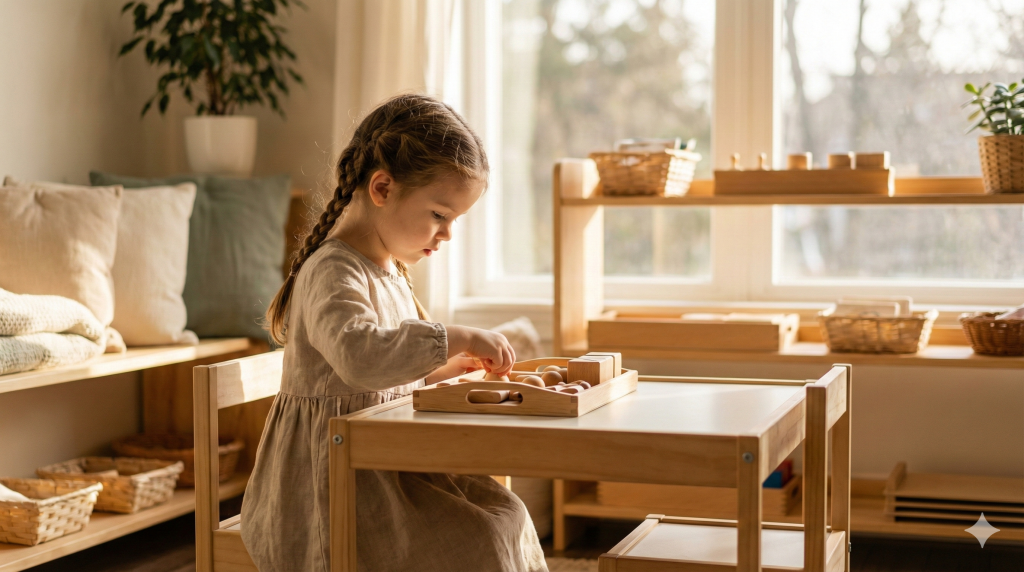
When a parent walks through our doors holding an infant for the first time, we understand the weight of that moment. This is not simply a decision about childcare. This is about entrusting us with the earliest, most formative years of a child’s life—a choice that requires courage, research, and ultimately, faith in what a consistent educational environment can achieve.
The journey from an infant program to a primary classroom is a beautiful milestone, and we know how important a consistent, nurturing environment is for that transition. See how one MRA family experienced this seamless growth, fostering a deep love of learning from the very beginning.
This is the story of that journey—one family’s experience across three pivotal years at Montessori Reggio Academy. While every child’s path is unique, the transformation we witness when families commit to this continuum reveals something profound about early childhood development and the power of educational continuity.
The Beginning: Choosing an Infant Program
The decision to enroll an infant in an educational program rather than traditional daycare often comes with considerable anxiety. Research confirms that parent confidence in their choice sets the tone for successful transitions. For the family at the center of this story, the search began with fundamental questions that many prospective parents share: Will my child be safe? Will they receive individualized attention? Is this truly educational, or simply supervision?
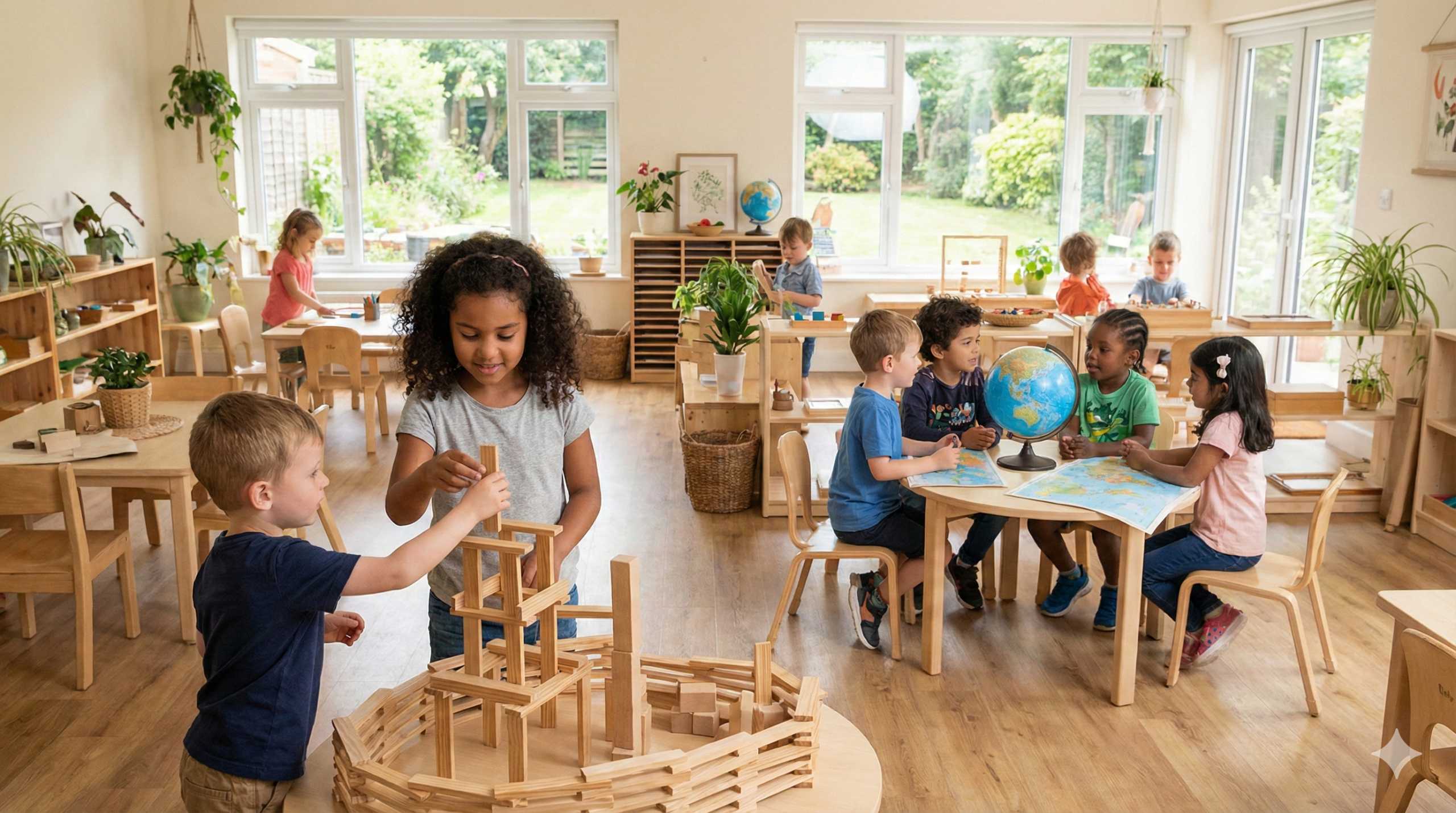
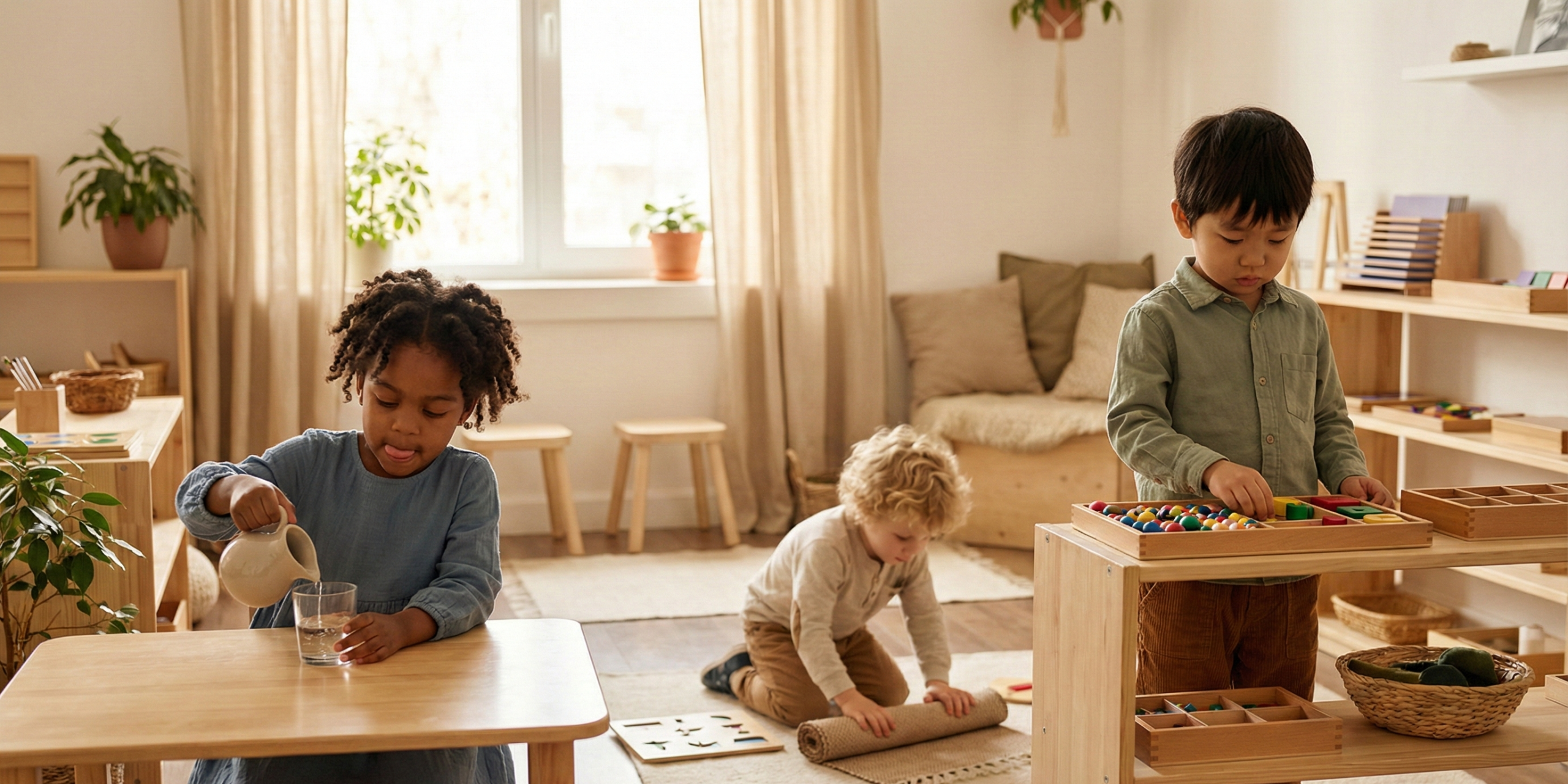
What distinguishes a Montessori infant program from conventional childcare lies in the intentional design of what Dr. Maria Montessori termed the “prepared environment.” In our infant classrooms, every element serves a developmental purpose. Child-sized furniture allows even our youngest learners to interact with their surroundings independently. Low, accessible shelves stocked with carefully curated sensory materials invite exploration rather than passive entertainment. Natural lighting and a neutral color palette create a calming atmosphere that supports focus and reduces overstimulation. Open floor space encourages freedom of movement—critical for infants developing the gross motor skills that will eventually lead to crawling, standing, and walking.
This family’s daughter entered our infant program at seven months. During those early weeks, our teachers observed her natural rhythms, noted her responses to different textures and sounds, and began building the foundation of trust that would define her educational experience. In Montessori philosophy, respect for the individual child’s pace is paramount. There is no pressure to meet arbitrary milestones on a predetermined schedule. Instead, caregivers provide responsive, individualized support that recognizes each infant as a capable learner with innate curiosity.
The parents noticed changes within the first month. Their daughter, who had been tentative about reaching for objects at home, began actively exploring materials in the classroom. She would spend extended periods examining a wooden rattle, rotating it in her hands, discovering how different movements produced different sounds. These moments of sustained concentration—what Montessori educators call “purposeful work”—were not accidental. They resulted from an environment specifically designed to support her emerging abilities and interests.
Building Foundations: The Toddler Years
As she approached eighteen months, the transition to our toddler program marked a significant developmental shift. The toddler years represent a period of extraordinary brain development—research indicates that 80 percent of a child’s brain architecture develops by age three. During this sensitive period, children are absorbing language, developing memory, and establishing thinking and reasoning skills at an unprecedented rate.
Our toddler classrooms expand upon the infant foundation by introducing increasingly complex materials and greater opportunities for independence. Practical life activities become central to the curriculum. Children learn to pour water from small pitchers, manipulate buttons and zippers on dressing frames, and participate in food preparation. These activities, which might appear merely domestic, actually develop fine motor control, hand-eye coordination, concentration, and—perhaps most importantly—a sense of capability and self-worth.
For this particular child, the toddler years brought visible growth in confidence and communication. Her vocabulary expanded from single words to complex sentences, accelerated by the rich language environment our teachers cultivate. In Montessori settings, adults speak to children with the same respect and grammatical precision they would use with other adults. There is no “dumbing down” of vocabulary. Instead, children are exposed to precise, descriptive language that expands their capacity for expression and comprehension.
The mixed-age structure of our toddler classroom—which includes children from approximately eighteen months to three years—played a crucial role in her development. She had the opportunity to observe slightly older peers demonstrating skills she was beginning to develop, providing both inspiration and practical demonstration. Research on mixed-age classrooms confirms that younger children benefit significantly from this peer modeling, while older children reinforce their own learning by teaching and guiding their younger classmates—a phenomenon psychologists call the “protégé effect”.
Her parents shared an observation that many families report during this stage: their child had developed an intrinsic motivation to learn. She was not complying with adult directives out of obedience; she was engaging in activities because they genuinely interested her. This internal drive—what Montessori education calls “the absorbent mind”—is the most reliable predictor of lifelong learning success.
The Transition: From Toddler to Primary
The move from our toddler program to the primary classroom (ages three to six) represents both a culmination and a new beginning. For many parents, this transition raises questions: Will my child, who has been among the oldest and most capable in the toddler room, struggle when suddenly becoming the youngest in a new environment? How will they handle the increased expectations for independence and self-regulation?
These concerns are valid. The transition from toddler to primary involves genuine developmental challenges. Children move from an environment where teachers provide considerable physical support to one where they are expected to independently select work, manage their time, and resolve conflicts with minimal adult intervention. The academic expectations also increase significantly, with the primary curriculum encompassing five core areas: practical life, sensorial exploration, language, mathematics, and cultural studies.
However, several factors inherent to the Montessori structure facilitate this transition. First, because children have spent their infant and toddler years in the same school with many of the same peers, they approach the primary classroom with established relationships and familiarity. The emotional security of these connections reduces the anxiety that often accompanies new environments.
Second, our teachers in the toddler and primary programs maintain close collaboration throughout the transition process. Several weeks before a child moves to primary, they begin visiting the new classroom for brief periods. They observe older children engaged in work, explore some of the materials, and gradually acclimate to the new space and routines. This gradual exposure—recommended by research on continuity of care—ensures that the physical transition happens smoothly while allowing the child to maintain emotional security.
For this family’s daughter, the transition occurred just after her third birthday. Her parents remember feeling more anxious than she appeared to be. On her first full day in the primary classroom, she walked in confidently, selected a familiar practical life activity (polishing silver), and worked with sustained concentration for nearly twenty minutes. The skills she had developed over two and a half years—the ability to choose meaningful work, to concentrate, to complete a task from beginning to end—transferred seamlessly to the new environment.
Thriving in the Primary Classroom: The Cambridge Difference
What distinguishes our primary program from other early childhood settings is the integration of the Cambridge Early Years framework with our Montessori and Reggio Emilia foundations. As Texas’ first Cambridge Early Years center, we provide a globally recognized educational structure that develops knowledge, understanding, and skills across six curriculum areas while honoring the child-centered, play-based approach that Montessori and Reggio philosophies champion.
The Cambridge framework supports children in developing at their own pace while ensuring they meet internationally established developmental milestones. For parents concerned about long-term academic preparation, this combination offers reassurance. Their child is not simply “playing”—they are engaging in purposeful, scaffolded learning experiences designed to build the foundational skills necessary for success in Cambridge Primary or any subsequent educational program.
In our primary classroom, this integration looks like a carefully curated balance. A child might spend the morning working independently with Montessori math materials, manipulating golden beads to understand place value and the decimal system. After lunch, they might collaborate with peers on a Reggio-inspired investigation of shadows, documenting their observations through drawings and photographs—a practice that makes their thinking visible and supports metacognitive development. Throughout the day, teachers observe and document each child’s progress across the Cambridge curriculum areas, ensuring comprehensive development in personal, social, and emotional skills; physical development; communication and language; literacy; mathematics; and understanding the world.
Now in her second year of primary, this child has blossomed into a confident, curious learner who exhibits remarkable independence. She selects challenging work that pushes her capabilities, whether tracing sandpaper letters to prepare for writing or working with the binomial cube to develop spatial reasoning and early algebraic thinking. When she encounters difficulty, she has learned to persist, to seek alternative approaches, and—when necessary—to ask for help from either a teacher or an older peer.
The mixed-age structure of the primary classroom continues to support her growth. She benefits from observing five- and six-year-olds engaged in advanced work, which provides both inspiration and a window into what she will eventually master. Simultaneously, she has begun to take on a mentorship role with newer, younger students, explaining how to carry materials carefully or demonstrating how to complete a practical life exercise. This reciprocal teaching deepens her own understanding while building empathy, patience, and leadership skills.
What This Journey Reveals About Early Childhood Development
This family’s experience illustrates several research-backed principles about early learning and development that inform everything we do at Montessori Reggio Academy.
Continuity of care produces measurably better outcomes. Research consistently demonstrates that when children remain with consistent caregivers and peers over an extended period—ideally two to three years—they develop more secure attachments, experience less stress, demonstrate smoother developmental progress, and exhibit fewer behavioral concerns. The stability of remaining in one educational community from infancy through the primary years allowed this child to form deep, trusting relationships with both adults and peers, creating the emotional foundation necessary for academic risk-taking and growth.
The prepared environment shapes development as powerfully as direct instruction. Montessori and Reggio philosophies both recognize the environment as a “third teacher”. By thoughtfully designing spaces with appropriate materials, natural light, order, and beauty, we create conditions that invite exploration, support concentration, and communicate respect for the child’s emerging capabilities. This child’s growing independence resulted not from adult directives but from an environment that made independence both possible and appealing.
Self-directed learning cultivates intrinsic motivation and academic achievement. Recent research comparing Montessori students with peers in conventional programs found that Montessori children demonstrated superior performance in reading, memory, executive function, and perspective-taking—and that these advantages sustained and even increased over time rather than fading. The freedom to choose meaningful work, combined with the structure of a carefully prepared environment, produces engagement that external rewards and punishments cannot replicate.
Mixed-age groupings reflect developmental reality. Children do not develop in lockstep with age-matched peers. A three-year age span accommodates the natural variability in development while providing continuous opportunities for peer learning, mentorship, and collaboration. This structure also eliminates the artificial competition that occurs when children are constantly compared to same-age classmates, replacing it with a collaborative community where each child’s unique developmental journey is honored.
Addressing the Doubts: What Parents Wonder
Even parents who witness their child thriving often harbor questions about the Montessori approach, particularly as they compare it to more traditional educational models.
Will this prepare my child for “real school”? This concern deserves a candid response. Montessori primary students often transition to traditional elementary settings, and research indicates they adapt successfully—in fact, they often enter with stronger executive function, self-regulation, and intrinsic motivation than their conventionally educated peers. The independence, time management skills, and love of learning cultivated in Montessori environments serve children well regardless of their subsequent educational path. That said, the transition does require adjustment. Children accustomed to self-directed learning and multi-age collaboration must adapt to teacher-directed instruction and age-segregated classrooms. Most navigate this successfully, but parents should be aware that the philosophies differ substantially.
Isn’t this approach too unstructured? This misconception arises from conflating freedom with chaos. Montessori education provides freedom within clearly defined limits. Children may choose their work, but they may not disrupt others. They may work at their own pace, but they must complete cycles of activity. The environment appears unstructured because you do not see all children doing the same thing simultaneously. In reality, the structure is profound—it simply resides in the environment and materials rather than in constant adult direction.
What about academic rigor? The Montessori primary curriculum is remarkably rigorous, introducing abstract mathematical concepts, phonetic reading, geography, botany, and zoology in ways that are developmentally appropriate and deeply engaging. The Cambridge Early Years framework ensures that this breadth of learning meets internationally recognized standards. Children are not simply exploring; they are systematically building knowledge across all domains. The difference is that they are building this knowledge through hands-on investigation and self-paced mastery rather than through rote memorization and uniform pacing.
Why Parents Trust Montessori Reggio Academy
Our responsibility extends beyond implementing sound educational philosophy. We must also earn and maintain the trust of families who are making one of the most significant decisions of their parenting journey.
Several factors distinguish Montessori Reggio Academy and have established us as an authority in early childhood education in the Katy and Sugar Land communities:
Our Cambridge Early Years distinction. As Texas’ first Cambridge Early Years center, we offer a globally recognized curriculum framework that provides structure, accountability, and a clear pathway for continued academic development. This distinction reflects our commitment to educational excellence that meets international standards while remaining deeply child-centered.
Our Cognia accreditation. This rigorous accreditation process evaluates every aspect of our program—from teacher qualifications to curriculum design to learning outcomes. Maintaining Cognia accreditation requires ongoing self-evaluation and continuous improvement, ensuring that we consistently meet the highest standards for educational quality.
Our longevity and community recognition. Eight consecutive years of receiving the Best of Sugar Land award reflects sustained excellence and family satisfaction. This recognition comes not from marketing but from the experiences of families who have entrusted us with their children’s early education.
Our synthesis of three world-renowned philosophies. The integration of Montessori, Reggio Emilia, and Cambridge approaches is not simply additive—it is synergistic. Montessori provides the framework for independence and self-directed learning. Reggio contributes its emphasis on documentation, creativity, and the hundred languages of children. Cambridge ensures global academic standards and comprehensive developmental assessment. Together, these philosophies create an educational experience that is greater than the sum of its parts.
Our diverse, global community. Our student body represents over thirty countries, creating a genuinely multicultural learning environment. This diversity is not incidental; it is central to our mission of developing globally-minded future leaders who understand, respect, and collaborate across cultural differences.
The View from Here: Looking Forward
Today, this family’s daughter is thriving in the second year of her primary cycle. She reads independently, works collaboratively on complex projects, and approaches challenges with the confidence of a child who has experienced consistent support and success. When asked what she loves about school, she talks about her friends, about the satisfaction of mastering the pink tower, about discovering that butterflies and moths are different.
Her parents reflect on their decision three years ago with gratitude and some amazement at how far their daughter has come. The infant who needed support to sit up independently is now a confident learner who selects challenging work, manages her time, resolves conflicts peacefully, and demonstrates genuine joy in discovery.
More significantly, they recognize that the foundation established in these early years will serve her throughout her educational journey and beyond. The executive function skills, the intrinsic motivation, the sense of capability, the comfort with diverse peers—these are not simply preschool outcomes. They are lifelong competencies that will serve her in elementary school, in adolescence, in higher education, and in her eventual career.
This is what we mean when we say “Learners Today, Leaders Tomorrow.” The learning happening in our infant, toddler, and primary classrooms is not preparation for life; it is life itself, fully engaged and richly experienced.
For Families Considering This Journey
If you are researching early childhood education options in Katy or Sugar Land, you likely share many of the questions and concerns this family navigated three years ago. The decision about where and when to enroll your child is consequential, and it deserves careful consideration.
We invite you to visit our campus, observe our classrooms in action, and speak with our teachers about their approach to early childhood education. Notice how children move through the environment—are they purposeful or aimless? Listen to how teachers speak to children—is their language respectful and precise? Observe the materials—are they beautiful, well-maintained, and accessible? Pay attention to your instincts. The right educational environment should feel both rigorous and nurturing, both structured and flexible.
Most importantly, remember that continuity matters profoundly. The advantage of beginning in an infant program and remaining through primary is not simply about convenience. It is about allowing your child to build deep relationships, to develop in an environment that knows them intimately, and to progress through sensitive developmental periods with consistent support. Research on continuity of care consistently demonstrates that children who experience this stability demonstrate better developmental outcomes across all domains.
The journey from infant to primary is indeed a beautiful milestone. When that journey occurs within a thoughtfully designed educational environment guided by proven pedagogical principles, it becomes transformative—not just for the child, but for the entire family.
People Also Ask
How do I know if my infant is ready to start at a Montessori school?
Readiness for an infant program is less about specific developmental milestones and more about family readiness and the quality of the program. Montessori infant environments are designed to support babies from as young as six weeks, with individualized care that respects each child’s unique developmental pace and needs.
What is the difference between a Montessori infant program and traditional daycare?
Montessori infant programs emphasize purposeful environmental design, individualized developmental support, and respect for the child as a capable learner, whereas traditional daycare primarily focuses on supervision and basic care. The prepared environment, specialized materials, and trained Montessori teachers create an educational experience rather than simply a caregiving arrangement.
How does the transition from toddler to primary classroom work in Montessori schools?
Transitions are carefully managed through gradual exposure, with children visiting the primary classroom multiple times before officially moving. Teachers in both programs collaborate closely, sharing observations about each child’s readiness, and the continuity of staying within the same school community significantly reduces transition stress.
Will my child’s Montessori education prepare them for traditional elementary school?
Research demonstrates that Montessori students transition successfully to traditional schools and often demonstrate superior executive function, self-regulation, reading skills, and intrinsic motivation compared to conventionally educated peers. The independence and love of learning cultivated in Montessori environments serve children well regardless of their subsequent educational path.
Ready to start your family’s journey from infant to primary? Visit our Katy campus and see how continuity of care transforms early childhood education. Schedule a tour to experience the environment that has earned the trust of families from over 30 countries.