When you walk into a preschool or early learning center for the first time, the questions arrive faster than the tour guide can answer them. Will my child be ready for elementary school? Will they develop creativity alongside academic skills? Will they learn to work independently and also collaborate with others? For parents in Katy and Sugar Land who are investing significant time, thought, and resources into choosing the right educational foundation, these concerns are not just valid, they are essential.
The challenge is that most early childhood programs ask parents to choose between competing priorities. Do you prioritize academic rigor or creative expression? Structured learning or child-led exploration? Individual mastery or social collaboration? At Montessori Reggio Academy, we have spent years developing an answer that refuses this false choice.
A Unique Educational Synthesis
At Montessori Reggio Academy, we’ve brought together three world-renowned educational philosophies to create one seamless, transformative experience for your child. This unique blend nurtures the independence of Montessori, the creativity of Reggio Emilia, and the global academic excellence of the Cambridge framework.
This is not simply three programs operating side by side in the same building. What distinguishes our approach is how these philosophies inform and strengthen one another in daily practice. A child in our classrooms experiences the careful developmental sequencing of Montessori materials, the open-ended creative provocations of Reggio Emilia, and the globally benchmarked learning outcomes of Cambridge Early Years, all within the same morning work cycle. The result is an educational environment where children develop both the confidence to pursue their own interests and the skills to meet internationally recognized developmental milestones.
The Independence Pillar: Montessori’s Foundation of Self-Directed Learning
The Montessori method, developed by Dr. Maria Montessori in the early 1900s, begins with a fundamental belief: children are naturally driven to learn, and given the right environment, they will teach themselves with remarkable focus and persistence. This philosophy manifests in what Montessorians call the “prepared environment”, a classroom where every element, from the height of the shelves to the weight of the materials, is designed to support a child’s independent exploration.
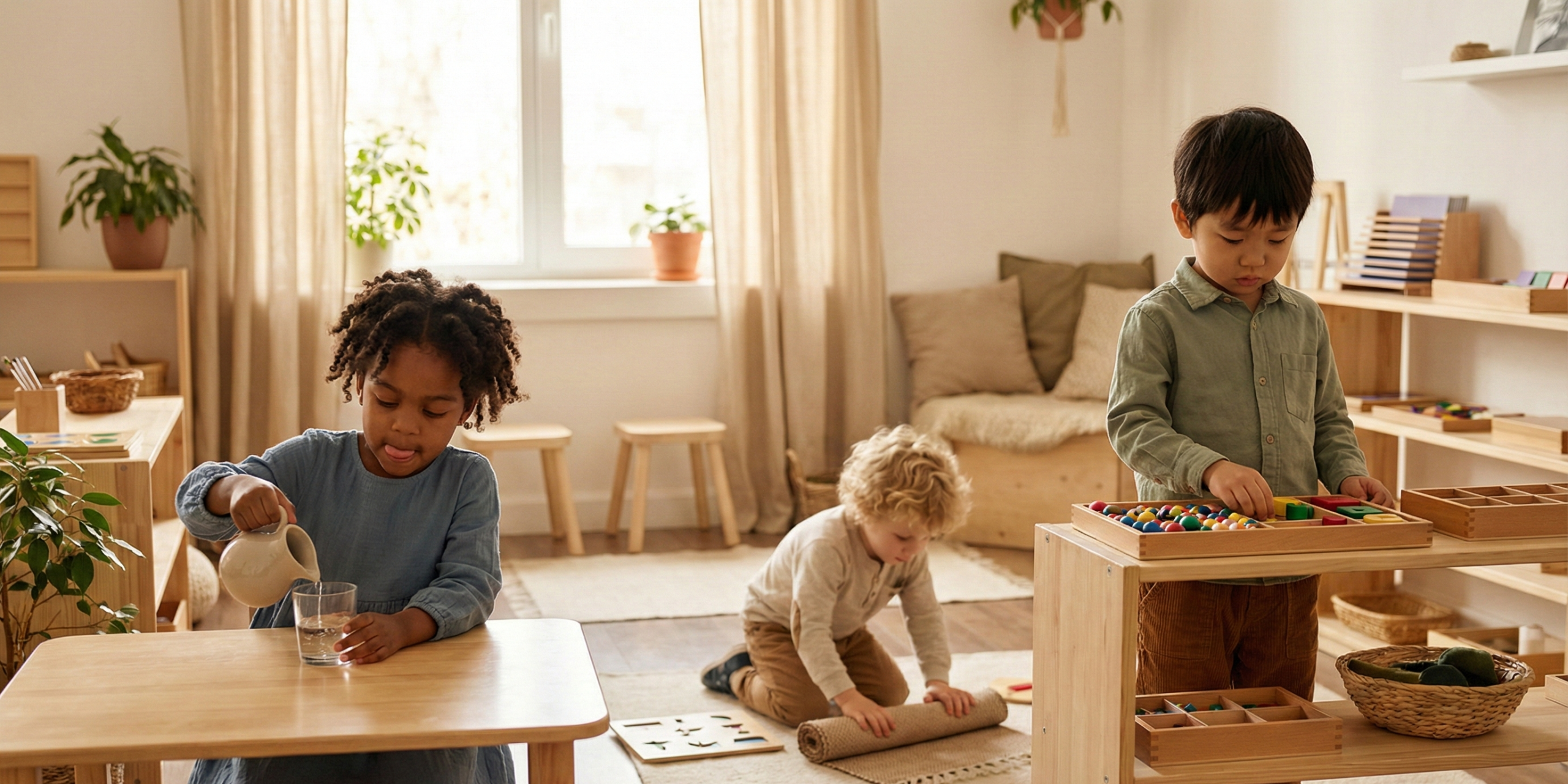
In our Montessori-inspired classrooms, children move freely through carefully organized learning areas: Practical Life, Sensorial, Language, Mathematics, and Cultural Studies. A three-year-old might spend twenty uninterrupted minutes mastering the pouring of water from pitcher to pitcher, not as a game, but as purposeful work that develops hand-eye coordination, concentration, and the deep satisfaction of competence earned through effort. These are not arbitrary activities. Each Montessori material isolates a specific concept or skill, allowing the child to focus, practice, and ultimately master it before moving to more complex work.
What parents often notice first in a Montessori environment is the absence of external rewards. There are no stickers for completing tasks, no gold stars on a chart. Instead, children develop intrinsic motivation, the understanding that learning itself is rewarding, that the ability to do something independently carries its own profound satisfaction. This shift from external validation to internal drive is one of the most valuable gifts we can offer a young child, and it serves them not just in school, but throughout life.
The mixed-age classroom structure further amplifies these benefits. In our Primary programs, children ages three through six learn together in the same space. Older children naturally take on mentorship roles, demonstrating activities they mastered the previous year to younger classmates. This peer teaching deepens the older child’s understanding, explaining a concept requires a level of mastery beyond simply performing it—while the younger child learns through observation and trusted guidance from someone closer to their own perspective. The result is a family-like community where empathy, patience, and leadership develop organically, without formal instruction.
The Creativity Pillar: Reggio Emilia’s Emergent Curriculum
While Montessori provides structure and developmental scaffolding, the Reggio Emilia approach contributes what might be described as educational oxygen, the space for children’s ideas to breathe, expand, and take unexpected directions. Originating in the town of Reggio Emilia, Italy after World War II, this philosophy positions the child not as a vessel to be filled with predetermined knowledge, but as a capable researcher with rights, agency, and “a hundred languages” for expressing understanding.
In a Reggio-inspired environment, learning emerges from children’s genuine questions and fascinations. A child’s observation that shadows change throughout the day might evolve into a weeks-long investigation involving shadow tracing, light table exploration, storytelling with shadow puppets, and collaborative art installations. The teacher’s role shifts from knowledge transmitter to co-researcher, asking open-ended questions that deepen inquiry rather than directing toward predetermined answers: “I wonder why the shadow is longer now than it was this morning?” “What do you think would happen if we moved the light source?”
This approach honors what Reggio educators call “the hundred languages of children”, the recognition that children think and communicate through drawing, movement, sculpture, dramatic play, music, and a multitude of other modes beyond conventional verbal and written language. When we document these diverse expressions, through photographs, transcriptions of children’s conversations, and displays of their work-in-progress, we make learning visible not just to parents, but to the children themselves. This documentation allows children to reflect on their own thinking, to see how their ideas have evolved, and to feel that their intellectual work is valued and respected.
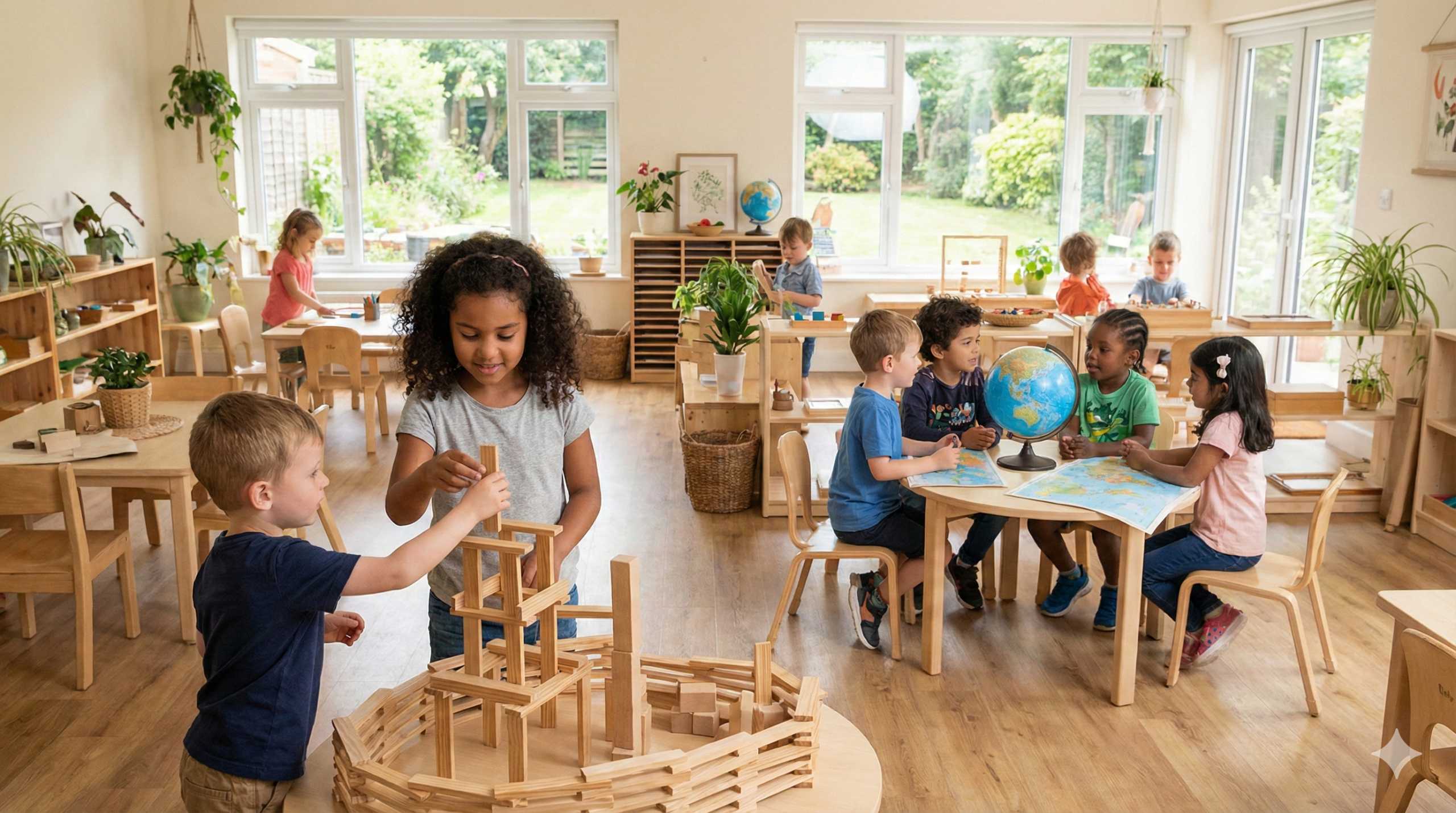
The Reggio Emilia principle of “the environment as the third teacher” also shapes how we design our spaces. Classrooms are aesthetically organized with natural materials, thoughtfully arranged provocations, and flexible areas that invite both solitary concentration and collaborative creation. Beauty is not decorative but functional, it communicates to children that they are in a place where careful thought, creativity, and their contributions matter.
The Global Excellence Pillar: Cambridge Early Years Framework
As Texas’ first Cambridge Early Years center, we anchor our integrated approach in a globally recognized framework that ensures our students are meeting internationally established developmental milestones while maintaining the flexibility to honor each child’s unique pace and interests. The Cambridge Early Years curriculum is not a prescriptive day-by-day lesson plan but rather a comprehensive structure that guides teaching and learning across six interconnected areas: Communication and Literacy, Mathematics, Understanding the World, Creative Expression, Personal and Social-Emotional Development, and Physical Development.
What distinguishes the Cambridge framework is its holistic philosophy. Rather than fragmenting a child’s day into isolated subject periods, Cambridge Early Years recognizes that young children learn through integrated experiences. A single morning might involve a child engaging with mathematical concepts through block building, developing literacy skills during a small-group storytelling session, and strengthening social-emotional understanding while negotiating roles in dramatic play, and all of these domains would be supported by Cambridge’s developmental learning statements.
The framework’s spiral approach means that children revisit key concepts with increasing depth and complexity as they mature. A three-year-old’s introduction to patterns through sensory play evolves into a four-year-old’s more sophisticated understanding through art projects, and eventually a five-year-old’s abstract reasoning about sequences and prediction. This recursive engagement ensures that foundational concepts are not just covered but deeply understood, creating the cognitive flexibility children will need as they transition to primary education.
Importantly, Cambridge Early Years is designed to be culturally responsive and adaptable. While it provides rigorous standards and clear learning outcomes, it also encourages educators to integrate local context, diverse perspectives, and bilingual approaches, values that align seamlessly with our multicultural community representing over thirty countries.
How These Three Pillars Work Together: The MRA Integration
The power of our approach lies not in offering three separate educational experiences, but in how these philosophies inform and strengthen one another in daily practice. Consider a typical morning in one of our Primary classrooms.
A small group of children becomes fascinated with the process of bread-making after a cultural studies lesson on grains. This interest sparks a Reggio-style emergent project. Over the coming weeks, children will photograph each stage of bread production, dictate their observations, create artistic representations of grain patterns, and build a collaborative display documenting their learning journey.
Simultaneously, individual children are working with Montessori practical life activities, measuring, pouring, mixing, that develop the precise motor control and sequencing skills needed for baking. Others are using Montessori sensorial materials to explore concepts of texture, temperature, and weight, refining their ability to discriminate subtle differences through touch and observation.
Throughout this project, our educators are using Cambridge Early Years learning statements to ensure that this rich, child-driven exploration is also building competencies across multiple developmental domains. They document evidence of growth in mathematical understanding (measurement, sequencing), communication skills (vocabulary development, procedural explanation), scientific reasoning (prediction and observation of chemical changes), and social-emotional learning (collaboration, patience, shared responsibility).
The child experiences this not as three separate curricula but as a coherent, meaningful investigation where they have both freedom to pursue their curiosity and support to develop specific skills. They are simultaneously independent and collaborative, creative and systematic, child-led and expertly guided.
A Morning in Our Classrooms: Where Philosophy Becomes Practice
To understand how this integration appears in practice, consider four-year-old Maya’s morning.
She arrives and, after a brief gathering where children greet one another and review the day’s possibilities, moves into the three-hour work cycle that is the heart of Montessori practice.
Maya chooses to work with the Pink Tower, a Montessori sensorial material consisting of ten graduated wooden cubes. She carries each cube carefully to her workspace, builds the tower from largest to smallest, then deconstructs and rebuilds it multiple times. She is developing visual discrimination of size, refining her gross and fine motor coordination, and practicing the concentration that will later support more complex cognitive work. No teacher hovers over her; she is trusted to work independently, to self-correct if the tower becomes unstable, to determine when she has completed this work to her satisfaction.
Later, Maya joins three classmates at a Reggio-inspired light table where they are exploring translucent materials, colored acetate, glass gems, natural objects. They arrange and rearrange materials, noticing how colors combine, how shadows form, how light transforms ordinary objects into something extraordinary. A teacher sits nearby, not directing but documenting, asking occasional questions that encourage deeper observation: “What happened when you placed the blue over the yellow?” “How is the shadow different from the object?”
As the morning progresses, Maya participates in a small-group mathematics activity aligned with Cambridge Early Years learning statements. The teacher introduces a pattern-making challenge using natural materials. Maya and her peers create increasingly complex patterns, explaining their thinking aloud, extending one another’s ideas. The teacher takes notes, photographs the children’s work, and mentally connects this experience to specific Cambridge developmental indicators she will later document.
Before the morning ends, Maya chooses to spend time in the classroom’s art atelier, a Reggio-inspired studio space. She has been working for several days on a clay sculpture inspired by the birds she observes at her home feeder. Today she adds details, explains her process to a visiting younger child, and decides to photograph her nearly-finished work so she can “remember how I made the wings.” Her teacher will add this photo and Maya’s dictated description to her learning portfolio, making her growth visible to her parents and to Maya herself.
This morning contains all three pillars, Montessori’s independent skill-building, Reggio’s emergent creativity and documentation, Cambridge’s developmental benchmarks, but Maya experiences it as simply a morning of meaningful, engaging work.
Why Parents Trust Montessori Reggio Academy
Our integrated approach is supported by credentials and recognition that demonstrate our commitment to educational excellence. As Texas’ first Cambridge Early Years center, we hold a distinction that no other school in the state can claim. This designation is not merely honorific; it represents Cambridge International Education’s rigorous evaluation of our curriculum, our teaching practices, and our commitment to global learning standards.
We are also proud to be Cognia-accredited, a recognition that reflects our adherence to comprehensive quality standards in early childhood education. Cognia’s accreditation process evaluates everything from our governance and leadership to our teaching practices, family engagement, and continuous improvement processes. Fewer than 10 percent of early learning programs nationwide pursue this level of external validation, because the standards are demanding and the review process is thorough. We have chosen to meet this higher bar because your child deserves an educational environment where quality is not assumed but rigorously demonstrated.
Our community’s recognition matters as well. We have been honored as “Best of Sugar Land” for eight consecutive years, an award determined by local families who have experienced our programs firsthand. This sustained recognition reflects not a marketing message but a lived reality, parents in our community consistently observe that their children thrive here, develop confidence and capability here, and leave us prepared not just for the next grade but for a lifetime of learning.
Finally, our multicultural community, representing families from over thirty countries, creates a learning environment where children develop global perspectives from their earliest years. In our classrooms, diversity is not a special curriculum addition but the daily lived experience. Children hear different languages, learn about varied cultural celebrations, and develop the fundamental understanding that there are many ways to see the world, many ways to solve problems, many ways to be.
Common Questions Parents Ask About Our Integrated Approach
Won’t three different philosophies confuse my child or create inconsistency?
This concern reflects a common misconception that integration means switching between contradictory approaches. In practice, these three philosophies share fundamental values: respect for the child as a capable learner, the importance of hands-on experience, recognition that children develop at individual paces, and belief in the power of thoughtfully prepared environments. The differences are complementary rather than contradictory. Montessori provides the developmental structure and independence skills; Reggio adds creative expression and collaborative learning; Cambridge ensures global standards and smooth transitions to primary school. Your child experiences this as a cohesive, well-supported educational journey, not a fragmented one.
How do you balance child-led learning with preparing my child for elementary school?
This question gets to the heart of why integration matters. A purely child-led approach, while respecting children’s interests, may not systematically develop the foundational skills children need for academic success. Conversely, a purely teacher-directed curriculum may build specific skills but at the cost of motivation, creativity, and the ability to direct one’s own learning. Our integrated model provides both: children have genuine choice and follow their interests within an environment carefully designed to ensure they encounter the materials, concepts, and experiences that build essential capabilities. The Cambridge framework gives us clear developmental milestones to work toward, while Montessori and Reggio philosophies provide the means to reach those milestones in ways that honor children’s natural learning processes.
My child is academically advanced (or needs extra support). Will this approach work for them?
The mixed-age classroom structure and individualized pacing that define Montessori practice make our environment exceptionally well-suited to children across the developmental spectrum. An academically advanced child can work with materials typically chosen by older classmates, challenged at precisely their level without being socially isolated from peers. A child who needs more time to master certain concepts can practice as long as necessary without the pressure of keeping pace with age-peers. The Reggio emphasis on diverse “languages” means that a child who struggles with conventional academic tasks may shine through artistic expression, building, or collaborative problem-solving. We do not teach to the middle; we teach to each child.
Frequently Asked Questions
What makes Montessori Reggio Academy different from other Montessori schools in the area?
While many excellent Montessori schools exist in the greater Houston area, Montessori Reggio Academy is the only school that integrates authentic Montessori practice with Reggio Emilia principles and the Cambridge Early Years framework. This synthesis means your child benefits from Montessori’s developmental approach while also experiencing the creative project-based learning of Reggio and the globally benchmarked curriculum of Cambridge. Our designation as Texas’ first Cambridge Early Years center is a distinction no other Montessori school in the state holds.
How do you document my child’s progress in this integrated environment?
We use multiple documentation methods that reflect our integrated philosophy. Children have individual portfolios containing photographs, work samples, teacher observations, and evidence of growth mapped to Cambridge learning statements. Parents receive regular narrative progress reports that describe development holistically rather than just assigning grades or scores. Reggio-style documentation panels displayed throughout our classrooms make children’s learning processes visible on an ongoing basis, and parents are invited to review and discuss these displays. Twice yearly, we conduct detailed parent-teacher conferences where we share comprehensive documentation of your child’s growth across all developmental domains.
At what age should my child start at Montessori Reggio Academy?
We serve children from infancy through elementary school, and we believe that the earlier a child joins our community, the greater the benefit. However, children joining at any age experience the advantages of our integrated approach. Younger children establish foundational independence skills and develop the concentration that will serve them throughout their educational journey. Children joining at age three or four quickly adapt to the classroom’s rhythm and often make remarkable developmental leaps in their first year. Even children who come to us at age five benefit significantly before transitioning to elementary school, developing self-direction and confidence that distinguish them in their next educational setting.
How does your program prepare children for traditional elementary schools?
This question often carries an underlying concern: will a child-centered, independence-focused early childhood program create challenges when children encounter more structured elementary environments? In practice, the opposite occurs. Children who have developed genuine self-discipline, who can focus for extended periods on challenging work, who take responsibility for their learning, and who possess both academic skills and social-emotional competence consistently excel in elementary school regardless of the setting. The Cambridge Early Years framework specifically includes transition planning to ensure children are prepared for their next educational stage. Parents and alumni consistently report that MRA graduates enter elementary school ahead of peers in independence, confidence, problem-solving capability, and foundational academic skills.
The choice of an early childhood program is among the most significant decisions you will make for your child. At Montessori Reggio Academy, we have created an educational environment that refuses to ask you to choose between independence and collaboration, between academic rigor and creative expression, between respecting your child’s unique pace and ensuring they meet global developmental standards.
Instead, we offer all of these, an integrated approach where three world-class educational philosophies strengthen one another in daily practice, where your child is known as an individual and grows within a community, where learning is both joyful and purposeful. We invite you to visit our campuses in Katy to observe our classrooms in action, and to discover what becomes possible when educational excellence comes not from choosing one pillar, but from standing firmly on three.
Ready to experience our integrated approach firsthand? Schedule a tour to see how Montessori, Reggio Emilia, and Cambridge come together to create a truly cohesive education for your child.