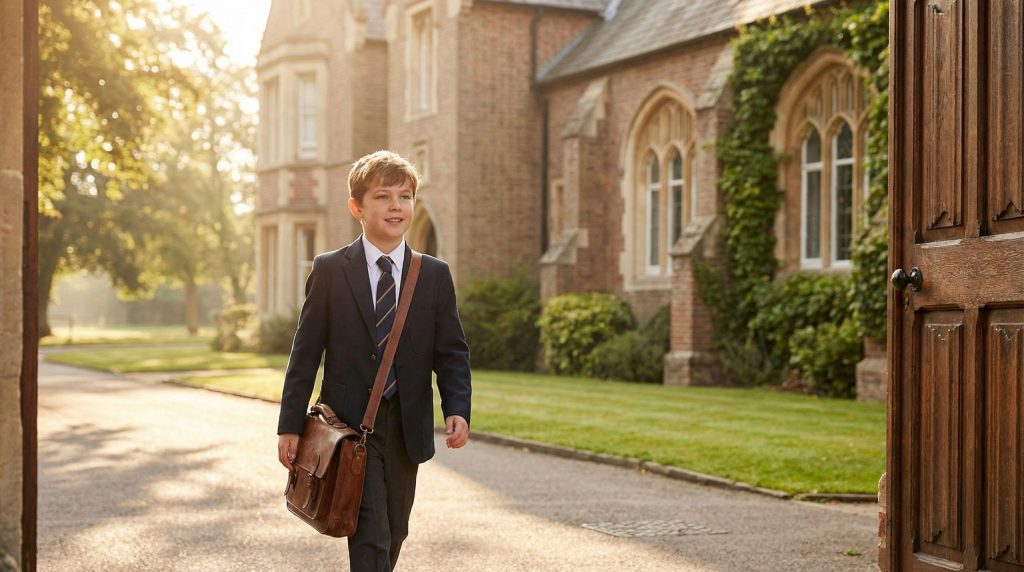
When a former parent reached out to share her son’s acceptance into one of Texas’ most prestigious preparatory schools, she offered a reflection that resonates with families across Katy and Sugar Land: “The difference between his public school experience and what he gained at MRA wasn’t just academic—it was transformational. The independence and confidence he developed here gave him an edge we didn’t fully appreciate until we saw him thrive in the admissions process.”
Graduates of our program consistently demonstrate the independence, confidence, and love of learning that top preparatory schools actively seek. This unique foundation gives our students a distinct advantage, preparing them not just for admission, but for success.
For parents evaluating early education as an investment in their child’s entire academic trajectory, understanding precisely how a Montessori foundation translates to preparatory school readiness requires looking beyond buzzwords to the daily realities of our classrooms.
What Preparatory Schools Really Look For
The admissions landscape at Texas’ leading private schools—St. John’s School, The Kinkaid School, and Episcopal High School among them—reflects a consistent truth: academic preparation alone does not secure admission or predict success. These institutions require ISEE testing, teacher recommendations, and interviews, but the students who thrive are those who arrive with something more fundamental.
Preparatory schools seek students who demonstrate self-directed learning capacity, time management skills, and the ability to navigate rigorous expectations with resilience. The college preparatory model operates on a premise of student independence—the expectation that learners will manage complex workloads, advocate for their needs, and engage in advanced study without constant supervision.
This is precisely where the Montessori difference becomes measurable.
The Neuroscience Behind Early Independence
Research published in Frontiers in Psychology reveals that adults who attended Montessori schools for at least two years report significantly higher well-being than those from conventional educational settings, with effects strengthening proportionally to time spent in Montessori environments. The mechanism driving these long-term outcomes centers on three factors: self-determination (children choose their own work and feel ownership of their education), meaningful engagement (activities have clear, authentic purposes), and social stability (multi-year classroom groupings with consistent teachers and peers).
A 2023 meta-analysis examining 32 comparative studies found that Montessori students performed approximately one-third of a standard deviation higher on non-academic outcomes including executive function, creativity, and social skills—precisely the competencies preparatory schools prioritize during evaluation.
Our former parent observed this foundation in her son directly: “In public school, he waited to be told what to do. At MRA, he learned to identify what needed to happen next and take action. That shift in mindset was everything.”
How MRA’s Prepared Environment Builds Preparatory School Skills
Self-Directed Learning Translates to Advanced Independent Study
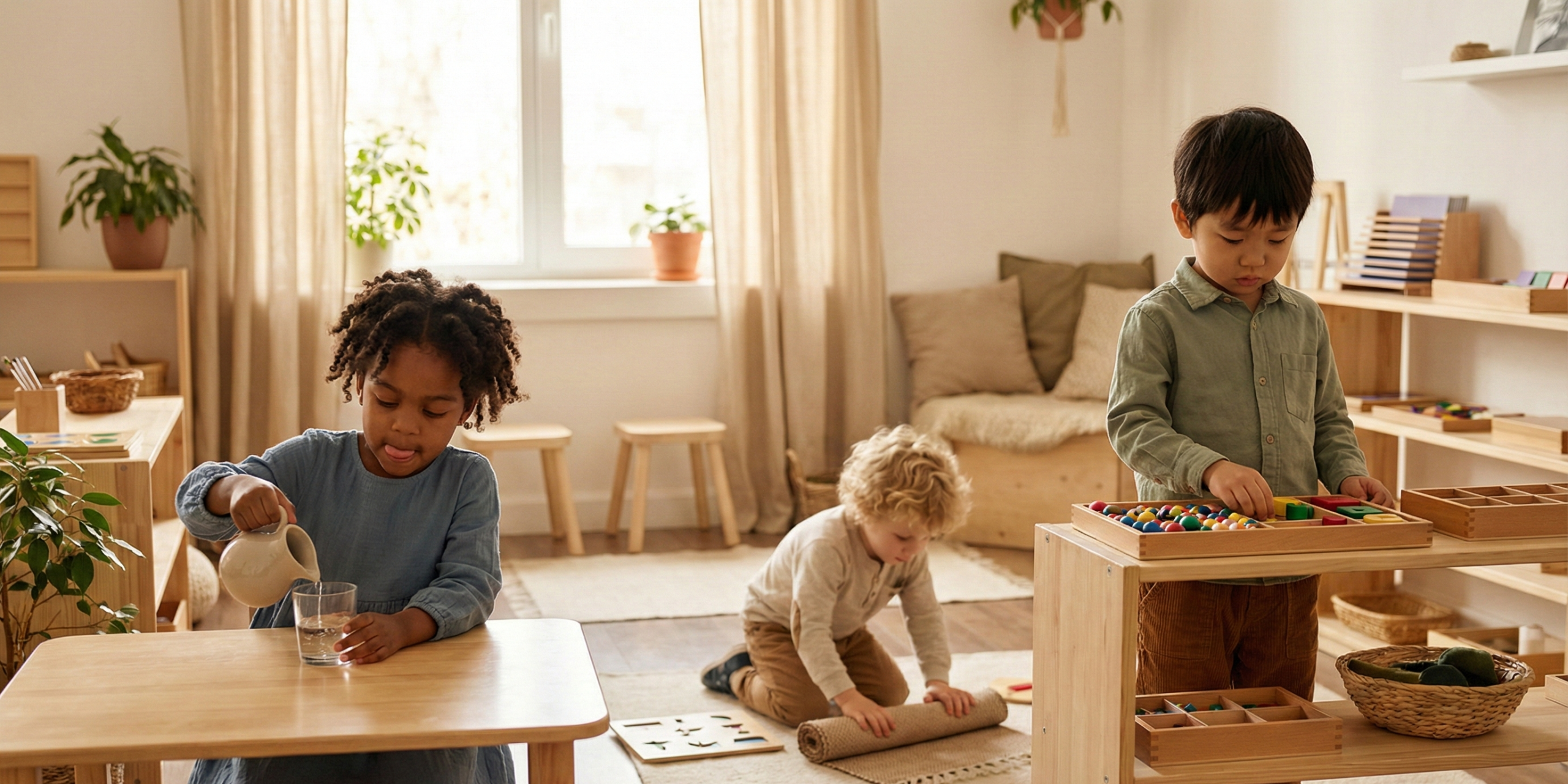
In our mixed-age classrooms, children as young as three begin making choices about their work within our carefully prepared environment. A child selects a practical life activity—perhaps polishing silver or arranging flowers—completes the multi-step process independently, and returns materials to their designated location. This sequence, repeated hundreds of times across developmental stages, constructs the neural pathways for self-regulation, focus, and task completion.
By the primary years, students are managing personal work plans, setting learning goals, and monitoring their own progress across content areas. This is not theoretical preparation for independence—it is the daily practice of independence itself.
When these students enter preparatory school environments where teachers assign complex projects with minimal scaffolding, they do not experience the paralysis many peers face. They have internalized the question “What do I need to do next?” and possess the executive function to answer it.
Mixed-Age Classrooms Cultivate Leadership and Social Intelligence
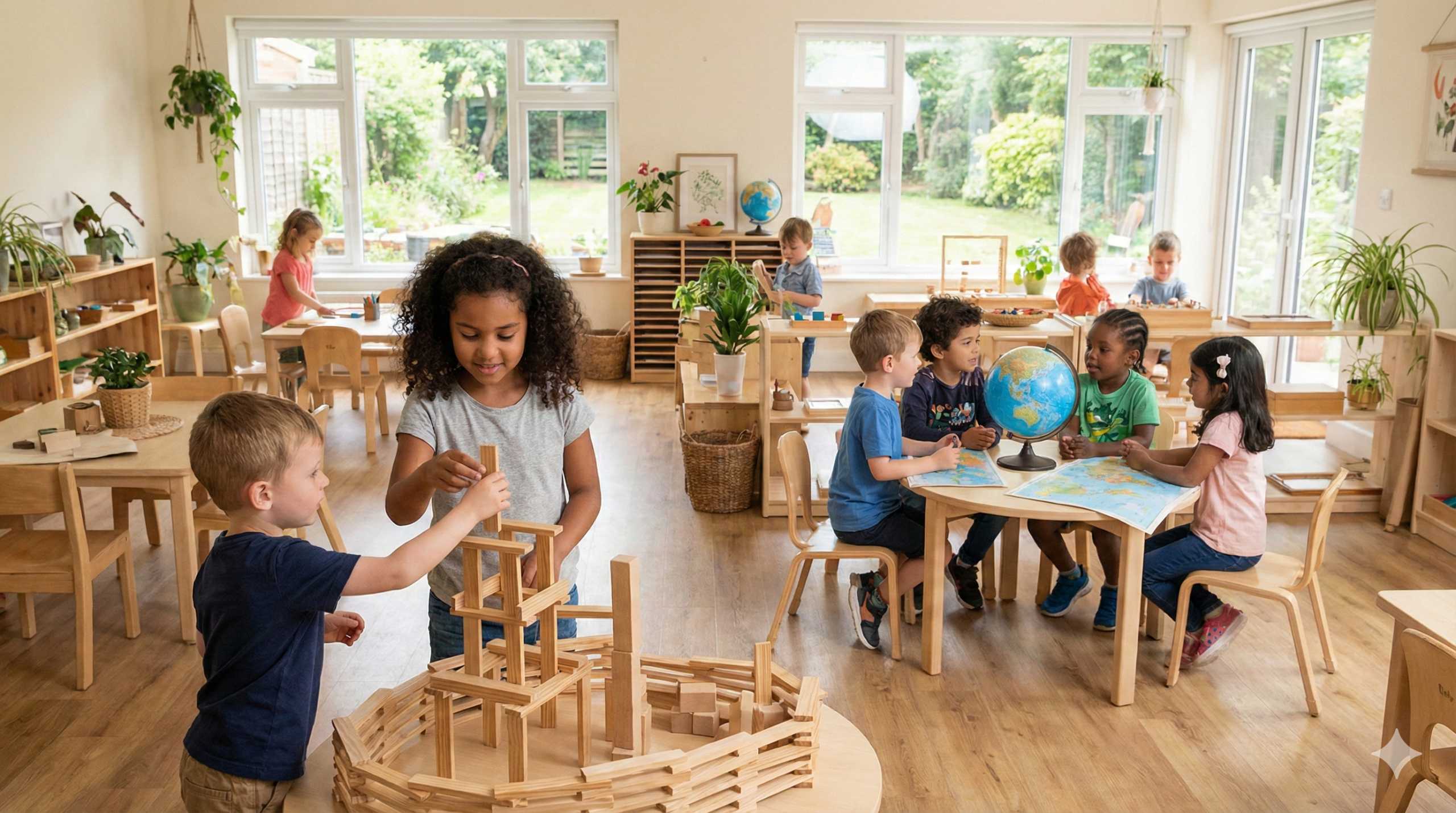
Our mixed-age groupings span three years, positioning every child as both learner and teacher depending on context. Younger children observe older peers demonstrating grace, courtesy, and sophisticated problem-solving approaches. Older children assume mentorship roles naturally, reinforcing their own mastery while developing empathy and communication skills.
This dynamic directly addresses preparatory school expectations for collaborative learning and peer leadership. Students who have spent years navigating relationships across age and ability levels arrive at preparatory schools with unusual social fluency. They understand how to contribute to group work without dominating, how to seek help without helplessness, and how to offer assistance without condescension.
One MRA graduate, now completing her first year at a competitive Houston preparatory school, reflected: “Being able to work with anyone on anything—that came from those mixed-age classrooms. I’m not intimidated by older students or impatient with younger ones. It just feels normal.”
Practical Life Activities Build Real-World Executive Function
The practical life area of our Montessori classrooms might appear simple to observers—children washing dishes, preparing snacks, caring for plants—but these activities are engineering executive function at the neurological level. Each activity requires planning (gathering materials), sequencing (executing multiple steps in correct order), quality control (self-assessment against a standard), and environmental responsibility (cleanup and restoration).
These are the identical cognitive processes required for managing the academic demands of preparatory school: breaking a research paper into stages, allocating time across subjects, assessing work quality before submission, and maintaining organizational systems. The difference is that MRA students have been practicing these patterns since toddlerhood, not scrambling to develop them under the pressure of ninth-grade expectations.
Cambridge Early Years Framework Adds Global Competence
As Texas’ first Cambridge Early Years center, we integrate a globally recognized framework that explicitly develops the knowledge, skills, attitudes, and values constituting global competence. This includes the capacity to examine issues from multiple perspectives, understand how cultural differences shape perception, and engage respectfully with diverse viewpoints.
Preparatory schools serving families with international aspirations and university pathways increasingly prioritize these competencies. Students who have developed cultural awareness, adaptability, and inclusive attitudes through our Cambridge-aligned curriculum enter secondary environments prepared not just academically, but as global citizens.
Why Parents Trust Montessori Reggio Academy
Choosing an early education program requires trust that today’s investment will yield tomorrow’s outcomes. Several factors distinguish MRA’s approach and substantiate our track record:
Cognia Accreditation: Our institutional accreditation confirms adherence to rigorous quality standards, differentiating us from unaccredited programs.
Cambridge Early Years Distinction: As Texas’ first Cambridge Early Years center, we offer a globally recognized framework unavailable at competitor schools, providing families with documented developmental progression and international portability.
Integrated Educational Philosophy: Unlike schools that identify as exclusively Montessori or Reggio-inspired, we deliberately synthesize three world-class approaches—Montessori’s independence-building, Reggio’s creativity and documentation, and Cambridge’s global academic standards—into a cohesive experience.
Extended-Age Programming: We serve families from infancy through elementary years, providing continuity of philosophy and relationship across the most formative developmental stages.
Longevity and Recognition: Eight consecutive years earning “Best of Sugar Land” reflects sustained community trust and satisfaction beyond marketing claims.
Common Parent Concerns About Montessori and Preparatory School Transitions
“Will my child struggle with the structure of traditional preparatory school after Montessori’s freedom?”
This concern misunderstands both Montessori philosophy and preparatory school realities. Montessori education is not unstructured; it provides freedom within carefully designed limits. Students learn to operate within frameworks, respect boundaries, and self-regulate—skills that transfer seamlessly to preparatory school expectations. Research confirms Montessori students transition successfully to traditional environments precisely because they have internalized the discipline conventional schools attempt to externally impose.
“Do Montessori students perform competitively on standardized admissions tests?”
Preparatory school admissions require ISEE testing, which assesses verbal reasoning, quantitative reasoning, reading comprehension, and mathematics achievement. Montessori students’ emphasis on conceptual understanding over rote memorization, combined with advanced literacy and mathematical reasoning developed through manipulative-based learning, positions them well for these assessments. The meta-analysis finding that Montessori students perform one-quarter standard deviation higher on academic measures supports this.
“What if my child doesn’t know they want to attend preparatory school yet?”
The skills MRA develops—independence, confidence, self-directed learning, executive function, social intelligence—are not preparatory-school-specific. They are human-being-specific. Whether your child ultimately attends a preparatory school, public magnet program, or different educational path entirely, these foundational competencies determine life outcomes. The parent whose son entered Texas preparatory school concluded: “We weren’t planning this pathway when he was three. But when the opportunity emerged, he was ready. That’s the gift of this education.”
The Skills Alignment: From MRA Classroom to Preparatory School Expectations
| MRA Foundation Skill | Preparatory School Application |
|---|---|
| Self-directed learning in mixed-age classroom | Readiness for advanced, independent study with minimal teacher scaffolding |
| Managing personal work plans and goal-setting | Time management across complex course loads and extracurricular commitments |
| Multi-step practical life activities requiring planning and sequencing | Executive function for long-term projects and research assignments |
| Peer mentoring and collaborative problem-solving in diverse age groups | Leadership in group work and inclusive team dynamics |
| Grace and courtesy lessons embedded in daily interactions | Social fluency in formal academic environments and interview settings |
| Cambridge Early Years global perspective and cultural awareness | Preparedness for diverse student bodies and international curricula |
| Observation-based assessment and intrinsic motivation | Self-advocacy and internal drive to excel beyond external reward systems |
Beyond Admission: Preparing for Success, Not Just Acceptance
Preparatory schools explicitly distinguish between students who gain admission and students who thrive once enrolled. Admission represents potential; success requires execution. The skills gap becomes visible within weeks: some ninth-graders manage their schedules, seek resources proactively, and navigate academic challenges with resilience. Others struggle with the transition from external structure to self-direction.
MRA graduates enter preparatory environments having already lived the daily reality of self-management. They do not need to suddenly develop time management skills under pressure—they have been practicing them in age-appropriate contexts for years. They do not need to learn self-advocacy when stakes feel high—they have been approaching teachers with questions since they were four.
This distinction between admission-ready and success-ready matters profoundly to families making tuition investments. Our former parent observed: “The first semester is when you really see the difference. Some families were surprised by how much independence was expected. We weren’t, because he’d been doing it for years.”
The Return on Investment: Long-Term Outcomes Beyond School
While this article focuses on preparatory school pathways, the research on Montessori long-term outcomes extends far beyond secondary education. The University of Virginia study tracking adults across age ranges found that Montessori graduates report higher well-being, life satisfaction, and sense of purpose decades after completing their education.
The meta-analysis revealing stronger executive function, creativity, and social-emotional skills translates to workplace success, relationship quality, and adaptive capacity throughout life. These outcomes reflect the reality that MRA is not preparing children specifically for one school or one pathway—we are cultivating human beings equipped to navigate whatever future they choose.
What This Means for Your Family’s Decision
If you are currently evaluating preschool options while thinking about your child’s middle school and high school trajectory, you are engaging in the kind of strategic planning preparatory schools value. The question is not whether your three-year-old will attend a preparatory school—it is whether they will develop the foundational competencies that enable success in any academically rigorous environment they choose.
Montessori Reggio Academy’s integrated approach—combining Montessori’s independence-building, Reggio’s creative expression, and Cambridge’s global framework—constructs this foundation systematically and developmentally. The mixed-age classrooms cultivating leadership, the practical life activities engineering executive function, the self-directed learning building intrinsic motivation—these are not add-ons or enrichments. They are the core of what we do, practiced daily from toddlerhood forward.
Our alumni outcomes reflect this foundation. The students who continue to preparatory schools do so having already internalized the skills their peers are scrambling to develop. The students who choose different pathways do so with identical confidence and competence.
The parent who shared her son’s preparatory school success concluded with advice that resonates: “Trust the process earlier than you think you need to. By the time you’re visiting preparatory schools in eighth grade, the foundation is already built. That’s what MRA does—it builds the foundation while they’re young enough that it becomes who they are, not what they’re trying to become.”
People Also Ask
How long should my child attend Montessori to see long-term benefits?
Research indicates children who attend Montessori for at least two years show measurably higher well-being and academic outcomes, with benefits increasing proportionally to time spent in the program. Completing the full three-year cycle within a mixed-age classroom allows children to progress from observer to apprentice to mentor, internalizing the independence and confidence preparatory schools seek.
Do preparatory schools prefer students from specific early education backgrounds?
Preparatory schools evaluate applicants based on demonstrated skills rather than school type, seeking students with self-directed learning capacity, time management, resilience, and social intelligence. Montessori graduates’ measurably higher executive function and self-regulation position them competitively regardless of the preparatory school’s pedagogical approach.
What if my child isn’t academically advanced—will Montessori still prepare them for preparatory school?
Montessori education meets children where they are developmentally, allowing each student to progress at their own pace without comparison to arbitrary grade-level expectations. This individualization builds confidence and intrinsic motivation particularly effectively for students who struggle in conventional settings, as they experience mastery without the pressure of keeping pace with same-age peers.
How early should we start thinking about preparatory school if we’re currently choosing preschool?
The foundational skills preparatory schools require—independence, executive function, self-regulation, social intelligence—develop most effectively during early childhood when neural pathways are maximally plastic. Families making preschool decisions with long-term trajectories in mind benefit from choosing programs that systematically cultivate these competencies from the earliest ages, rather than attempting to develop them under pressure years later.
Ready to invest in your child’s long-term academic success? Visit our Katy campus and see how MRA builds the foundation that preparatory schools seek. Schedule a tour to discover how our integrated Montessori, Reggio Emilia, and Cambridge approach prepares children not just for admission, but for success.