The first conversation about your child’s education is often the most important. When parents arrive at our campus in Katy, they frequently ask the same question: “What makes your infant and toddler programs different from the daycare options down the road?” It’s a fair question, and one that deserves more than a marketing answer.
We believe a child’s first school experience should be more than just safe—it should be transformative. Our infant and toddler programs use proven Montessori principles to build a foundation of confidence and curiosity that will serve your child for a lifetime.
That distinction between “safe” and “transformative” is not semantic. It reflects a fundamental difference in philosophy, structure, and educational science that defines everything from how our classrooms are designed to how our educators interact with an eight-month-old during a diaper change.
The Critical Window: What Neuroscience Tells Us About the First Three Years
Every parent knows their child develops rapidly in the first years of life. What fewer parents realize is the staggering scale of that development at the neurological level.
During the first three years, a child’s brain is wiring itself at an astonishing rate—up to two million neural connections every second at its peak. By age three, the brain has already reached approximately 80 percent of its adult volume. A two-year-old’s brain contains nearly 50 percent more synapses than an adult brain, creating a period of extraordinary plasticity where early experiences don’t just influence development—they literally shape the physical architecture of the brain.
This is not simply a period of growth. It is a series of overlapping critical and sensitive periods during which the brain is biologically primed to acquire specific skills. Language networks form their foundational structures. Emotional regulation circuits are established. Movement patterns become encoded. The quality of the environment during these windows has lasting implications that persist well into adulthood.
The question for parents, then, is not whether their child needs care during these years. It’s whether that care is intentionally designed to support what the child’s brain is actively trying to accomplish.
The Montessori Difference: A Scientific Pedagogy for the Youngest Learners
Dr. Maria Montessori developed her method through years of systematic observation and experimentation—what she called “scientific pedagogy.” For infants and toddlers, this approach rests on several core principles that align precisely with contemporary neuroscience.
The Absorbent Mind (Birth to Age Six)
Montessori recognized that young children don’t learn the way older children or adults do. Between birth and approximately age six, children possess what she termed an “absorbent mind”—an unconscious, effortless capacity to take in everything from their environment. This is the neurological reality behind why infants raised in bilingual households can acquire two languages simultaneously without formal instruction, or why toddlers in our classrooms can master complex practical life sequences through observation and repetition.
Our infant and toddler environments are designed around this principle. Every material, every piece of furniture, every interaction is selected to provide rich, purposeful input during this peak period of absorption.
Sensitive Periods: Windows of Accelerated Learning
Montessori identified several sensitive periods during the first three years, times when children are biologically driven toward specific types of learning:
- Movement (birth to 2.5 years): Infants progress from reflexive movements to intentional reaching, grasping, rolling, crawling, and eventually walking. In our Nido (infant) environment, we support this progression not by restricting movement in bouncy seats or containers, but by providing floor mats, pull-up bars, and safe spaces for exploration. Movement is not incidental to cognitive development—it is essential to it.
- Language (birth to 6 years, with rapid spoken language development from 7 months to 3 years): The brain is forming its phonetic map during this window. We speak clearly and authentically to even our youngest children, narrate daily routines, and create rich opportunities for communication well before speech emerges.
- Order (6 months to 4 years, peaking in early toddlerhood): Young children develop an internal sense of organization by experiencing external consistency. Predictable routines, carefully organized environments, and respectful transitions provide the security toddlers need as they construct their understanding of how the world works.
- Refinement of the Senses (1 to 6 years): Sensory exploration through natural materials—wooden grasping toys, fabric textures, varied sounds and sights—builds the neural foundations for later abstract thinking.
We don’t simply accommodate these sensitive periods. We structure the entire program around them.
The Prepared Environment: Intentional Design for Developmental Readiness
Walk into a Montessori infant or toddler classroom and you will immediately notice what is absent: the visual chaos of primary-colored plastic, the restriction of movement, the constant redirection of adult-led group activities.
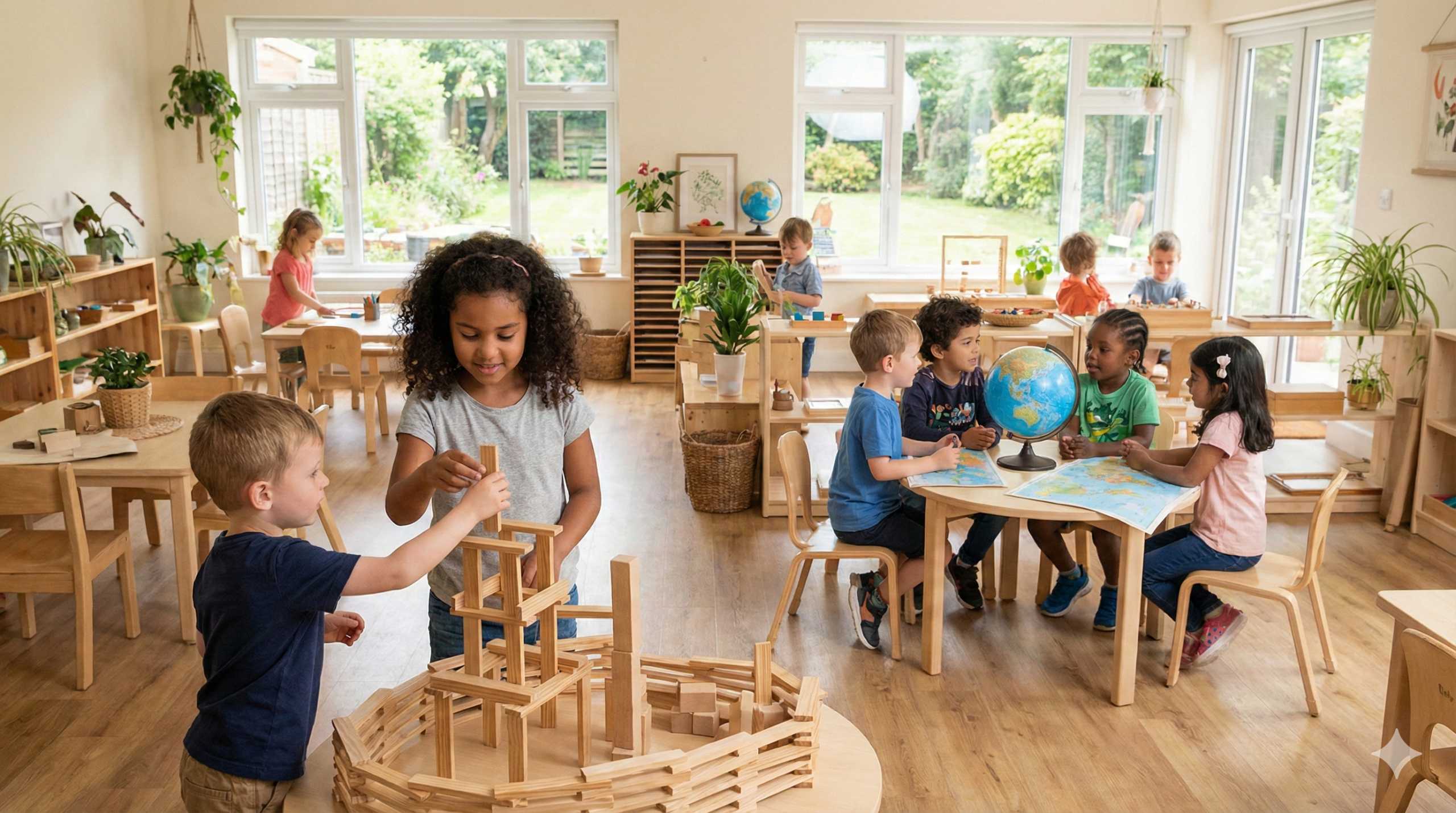
What you will see instead is a calm, ordered space designed at the child’s scale. Low shelves hold a carefully curated selection of materials, never too many, to promote focus rather than overwhelm. Mirrors positioned at floor level invite self-recognition. Child-sized tables and chairs allow toddlers to eat and work independently. Natural light, soft tones, and thoughtful organization create an environment that communicates respect.
This is the “prepared environment”—a cornerstone of Montessori philosophy that reflects Reggio Emilia’s concept of the environment as the “third teacher.” Every element has a developmental purpose.
For our youngest infants, floor beds replace cribs, allowing freedom of movement as soon as they are developmentally ready. Pull-up bars support the drive to stand. Low stairs provide safe climbing practice. These are not conveniences. They are scientifically grounded responses to the child’s inner developmental timetable.
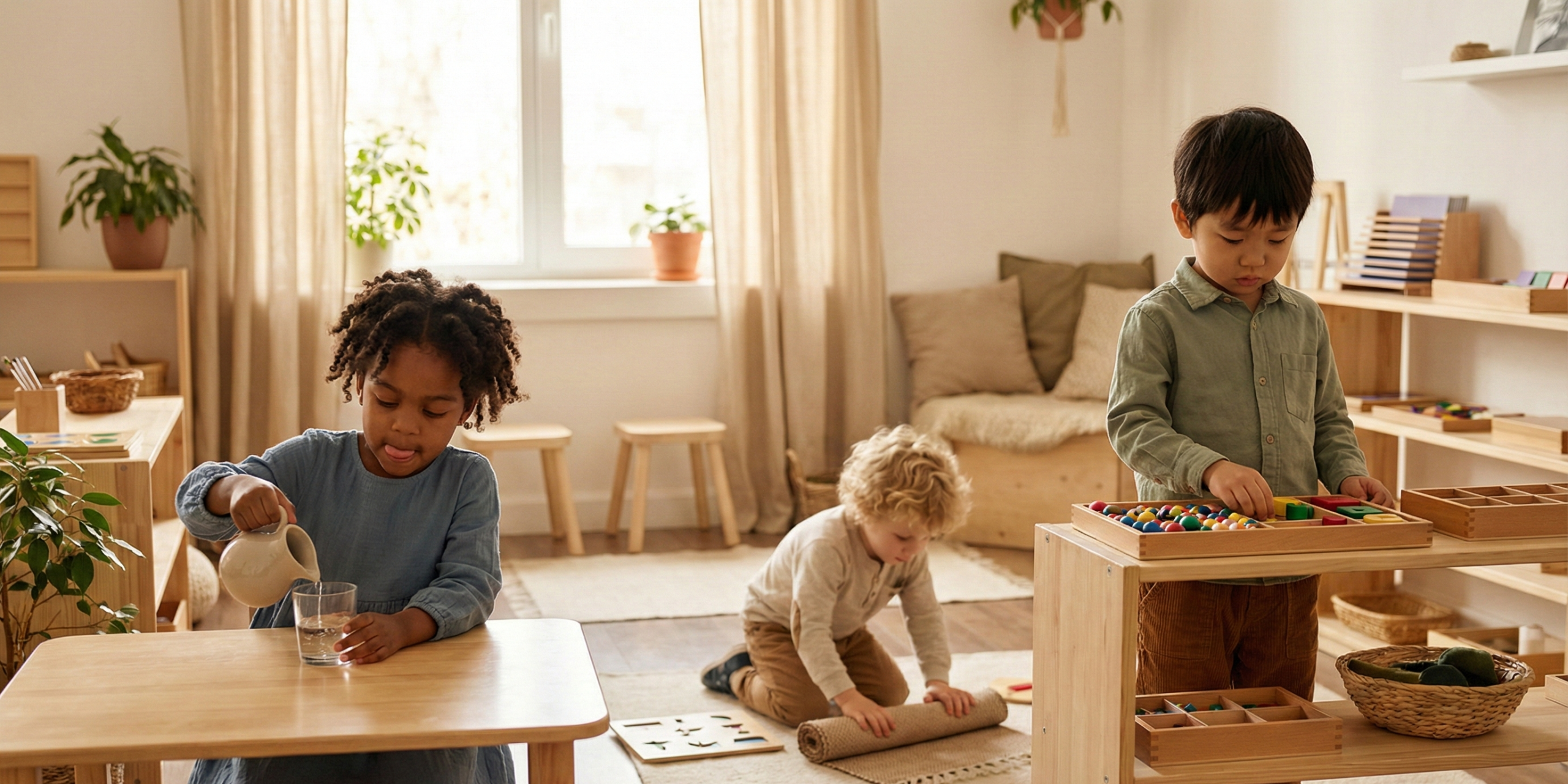
For toddlers, the environment expands to include practical life activities—pouring, spooning, washing, dressing, food preparation—that build fine and gross motor coordination, concentration, independence, and executive function. A toddler scrubbing a table is not playing. They are developing the neural pathways for sustained attention, sequential thinking, and voluntary control of movement.
Respect for the Child: Care as a Developmental Opportunity
Perhaps the most profound difference between a Montessori infant program and traditional daycare is how we approach care routines.
Diapering, feeding, and dressing are not tasks to be completed efficiently. They are extended, respectful interactions where we speak to the child, explain what is happening, and invite participation. Even a four-month-old is addressed as a capable person whose cooperation we seek, not a passive recipient of care.
As toddlers gain skills, we step back. We allow them the time—and the inevitable mess—that comes with learning to pour their own water, wash their own hands, or pull on their own shoes. The goal is not convenience. It is the child’s growing sense of competence, agency, and self-worth.
This is what Montessori meant when she wrote that the child’s inner plea is “Help me to do it myself.” Our role is not to do for the child what they can do for themselves, but to prepare an environment where independence becomes possible.
How the MRA Environment Supports Key Developmental Milestones
To understand how these principles translate into practice, consider the developmental progression from birth through age three and how our program supports each phase:
Birth to 6 Months: Building Trust and Sensory Foundations
Milestones: Infants develop visual focus (initially 13 inches, gradually extending), recognize familiar faces and voices, respond to sounds and facial expressions, begin reaching and grasping.
How MRA Supports This: In our Nido, infants have freedom of movement on soft mats rather than restrictive seating. Mobiles hung at appropriate heights support visual tracking. Mirrors encourage self-awareness. Educators speak directly to infants, narrate care routines, and respond consistently to cues, building secure attachment and trust.
6 to 12 Months: Movement, Exploration, and Object Permanence
Milestones: Sitting independently, crawling, pulling to stand, understanding object permanence, beginning intentional communication through gestures.
How MRA Supports This: Pull-up bars and low furniture support gross motor development. Baskets of natural objects (wood, fabric, metal) provide safe sensory exploration. Simple cause-and-effect materials introduce early problem-solving. Care routines continue to build language comprehension even before speech emerges.
12 to 18 Months: First Steps and Emerging Independence
Milestones: Walking independently, pointing to communicate, following simple directions, beginning to help with dressing, saying first words (10-20 by 18 months).
How MRA Supports This: The toddler environment includes low sinks for hand washing, child-height coat hooks, and simple practical life activities like transferring objects. Children practice pouring, spooning, and beginning self-care. Educators model language clearly and give children ample time to respond and attempt new skills.
18 to 24 Months: Language Explosion and Social Awareness
Milestones: Vocabulary rapidly expands, children begin to notice others’ emotions, exhibit both defiant behavior and desire for autonomy, imitate adult actions, develop self-awareness.
How MRA Supports This: Practical life activities expand to include sweeping, wiping tables, food preparation, and care of plants. Mixed-age groupings allow younger toddlers to observe and learn from older peers. Educators support emotional regulation by naming feelings, modeling calm responses, and providing consistent routines during this period of internal conflict between independence and reassurance.
24 to 36 Months: Confidence, Competence, and Early Problem-Solving
Milestones: Complex imitation of daily routines, ability to sort and categorize, recognizing one’s own reflection, pride in accomplishments, dramatic play, significantly increased language.
How MRA Supports This: Children engage in multi-step practical life sequences, care for the classroom environment, participate in simple cooking activities, and begin early collaborative work. Sensorial materials introduce concepts of size, weight, texture, and dimension. Freedom of choice within the prepared environment allows children to follow their interests while developing concentration and task completion.
Montessori Infant and Toddler Programs vs. Traditional Daycare
Parents researching early childhood options often use the terms “daycare” and “preschool” interchangeably. The distinction matters.
Traditional daycare centers provide supervision and basic care—critically important services for working families. Staff ensure children are safe, fed, and engaged in play. Group activities follow adult-set schedules, with transitions every 20 to 40 minutes. The environment is typically adapted from adult living spaces, with toys and activities that may be overstimulating or developmentally mismatched.
Montessori infant and toddler programs operate from a fundamentally different premise: that these years represent a once-in-a-lifetime opportunity for brain development, and that the environment should be intentionally designed to support what the child is biologically driven to achieve.
The contrast appears in daily practice:
- Environment: Montessori spaces are designed for the child’s independence—low shelves, child-sized furniture, carefully selected materials. Daycare spaces are designed for adult supervision and group management.
- Caregiving: In Montessori programs, routines like diapering and dressing are treated as learning opportunities where adults slow down, communicate clearly, and invite participation. In daycare, these tasks are often completed efficiently to manage group needs.
- Learning approach: Montessori environments support self-directed exploration at the child’s pace. Daycare typically relies on adult-led group activities, frequent transitions, and teacher-directed schedules.
- Movement: Montessori recognizes movement as essential to cognitive development and designs spaces that encourage it. Daycare often limits movement for safety or logistical reasons.
- Teacher training: Montessori infant/toddler educators complete specialized training in child development, Montessori pedagogy, and the specific materials and methods for this age group. Daycare requirements vary widely.
- Outcomes: Research indicates that children in Montessori infant/toddler programs develop stronger independence, concentration, communication skills, and confidence—qualities that persist as they transition to primary programs and beyond.
The difference is not warmth or care. It is intention. It is the recognition that children from birth to three are not simply waiting to be old enough for “real” school. They are in the midst of the most profound learning of their lives.
Why Parents Trust Montessori Reggio Academy
Cognia Accreditation: A Commitment to Excellence
Our Cognia accreditation represents a rigorous, ongoing commitment to quality that distinguishes MRA from the vast majority of early learning centers. Cognia Early Learning Accreditation involves a comprehensive evaluation against 32 specialized standards designed specifically for PreK institutions—distinct from K-12 standards and focused on the unique needs of our youngest learners.
The accreditation process includes self-assessment, external review by trained evaluators, and continuous improvement cycles every six years. Cognia’s framework emphasizes four key characteristics: culture of learning, leadership for learning, engagement of learning, and growth in learning. Fewer than 1,200 early learning institutions nationwide have achieved this recognition.
For parents, Cognia accreditation provides independent verification that MRA meets the highest standards of educational quality and effectiveness. It signals that we are not simply operating classrooms—we are participating in a structured, evidence-based process of institutional accountability.
The Cambridge Early Years Advantage
As Texas’ first Cambridge Early Years Center, we provide a globally recognized framework that enriches our Montessori and Reggio Emilia foundation. The Cambridge Early Years curriculum, designed for ages 3 to 6, is the first stage of the Cambridge Pathway—a coherent educational progression that extends through age 19 and is used in 160 countries.
The curriculum focuses on six key developmental areas: Language and Communication, Mathematics, Understanding the World, Creative Expression, Personal and Social-Emotional Development, and Physical Development. It emphasizes play-based, child-centered learning that supports the transition from informal exploration to more structured primary education.
At MRA, Cambridge Early Years does not replace our Montessori and Reggio Emilia approaches—it integrates with them. The Cambridge framework provides learning objectives and developmental benchmarks that complement Montessori’s prepared environment and self-directed learning. Reggio Emilia’s documentation practices align naturally with Cambridge’s emphasis on observation-based assessment.
This integration positions our students not just for success in the next grade, but for participation in a globally benchmarked educational pathway recognized by universities and education systems worldwide.
Eight Years as “Best of Sugar Land”
Parents trust recommendations from their community. Our designation as “Best of Sugar Land” for eight consecutive years reflects the experiences of hundreds of families who have watched their children grow from infants through primary programs at MRA. This sustained recognition is not a marketing claim—it is a pattern of parental satisfaction and confidence in the education their children receive.
A Multicultural Community Representing Over 30 Countries
Our community reflects the diversity of the world our children will inherit. With families representing more than 30 countries, our classrooms provide daily opportunities for children to experience different languages, customs, and perspectives from their earliest years. This global lens, integrated with our Cambridge framework, prepares children not just academically but culturally for an interconnected future.
Addressing Common Parent Concerns
“Is my child too young for a school program?”
The term “school” often carries connotations of formal instruction unsuited to infants and toddlers. Montessori infant and toddler programs are not school in that traditional sense. They are carefully prepared environments where children’s natural developmental drives are supported, not imposed upon.
The first three years are not “pre-education.” They are education in its purest form—the period when the brain is most receptive, most plastic, and most capable of foundational learning. The question is not whether your child is ready for this kind of environment. It’s whether the environment is prepared to meet your child where they developmentally are.
“How can I justify the cost compared to standard daycare?”
The financial investment in early education is significant. National data indicates that infant care at center-based programs ranges from approximately $650 to $1,500 per month, while preschool programs average $400 to $1,300. Montessori programs, with specialized teacher training, lower student-teacher ratios, and curriculum-rich environments, typically position toward the higher end of this range.
The value proposition rests on a simple premise: you are not purchasing childcare hours. You are investing in the neurological foundation for everything that follows.
Research consistently demonstrates that high-quality early childhood education produces measurable long-term outcomes—stronger executive function, better self-regulation, enhanced social-emotional skills, and improved academic readiness. The return on this investment compounds over time.
Choosing a premium program is choosing to optimize the period of maximum brain plasticity rather than treating it as a holding pattern until “real school” begins.
“What happens during the transition from infant to toddler to primary?”
One of the distinct advantages of a birth-through-primary program is developmental continuity. Children who begin in our Nido at six months and remain through the toddler community and into our primary program experience a seamless progression. The philosophy remains consistent. The approach to the child as a capable, respected individual does not change. Educators know the child’s history, temperament, and developmental trajectory.
This continuity eliminates the common disruptions that occur when children transition between fundamentally different educational philosophies. The confidence and independence developed in the infant and toddler years become the foundation for the more complex academic and social work of the primary program.
Frequently Asked Questions
Q: At what age can my child start in the infant program, and how do you support the youngest learners?
Children can begin in our Nido (infant environment) as early as six weeks, though most families enroll between three and six months. We support our youngest learners through freedom of movement (floor mats rather than restrictive seating), responsive caregiving that treats every routine as a learning opportunity, and carefully designed sensory materials that support visual tracking, reaching, grasping, and early problem-solving.
Q: How do Montessori principles apply to children who can’t yet walk or talk?
Montessori’s core principles—respect for the child, the prepared environment, sensitive periods, and the absorbent mind—are especially powerful for preverbal children. We communicate clearly even with infants, narrate our actions during care routines, give children time to respond, and design the space to support whatever developmental stage they’re in. Movement and language development begin long before walking and talking, and our environments are structured around those foundational processes.
Q: What qualifications do your infant and toddler educators have?
Our infant and toddler educators hold specialized Montessori credentials for the 0-3 age range, which requires extensive training in child development, Montessori pedagogy, practical life activities, sensorial materials, and observation techniques. Many also hold early childhood education degrees and participate in ongoing professional development through our Cognia accreditation process and Cambridge Early Years training.
Q: How does the program prepare my child for the transition to a primary classroom?
Children who complete our infant and toddler programs enter the primary environment with established concentration, independence, coordination, and a sense of order—the foundational skills Montessori primary work builds upon. The transition is seamless because the philosophy and respect for the child remain consistent. Educators already know your child, and your child already understands how to work within a prepared environment, choose activities, and care for their space and materials.
Ready to see the difference a Montessori infant and toddler program can make? Visit our Katy campus and experience our prepared environments firsthand. Schedule a tour to discover how our science-based approach transforms the earliest years into a foundation for lifelong learning.